I’d like to preface this article with a reminder that my experience is not everyone’s experience. Each person’s relationship with their disability is nuanced and the challenges it poses with the systems that be are unique. Hopefully, in my story, we can discover a sense of collectivity from which to envision a better future for Hunter students with disabilities.
A few months ago, I turned to the Hunter College Students Facebook group for what I thought was a shot in the dark but ended up being a place of solidarity for Hunter students with disabilities and chronic illness.
I felt angry. Angry that in my three years at Hunter, I repeatedly encountered denial, mockery, disbelief and passivity from professors toward my disability. I was curious to know how widespread this issue was, so I asked other students: Am I alone in this experience? Have I simply been unlucky?
I was surprised to find out how deeply my post resonated. In the comments, students with disabilities responded with personal anecdotes of how their needs were neglected by professors. Students’ names are omitted to protect their privacy.
“They aren’t sympathetic at all,” said one student.
“One of the biggest problems is that YOU who are suffering have to go to them to basically grovel for lenience and hope they actually do something to help,” said another.
Another student described being denied leniency despite testing positive for COVID-19. “The teacher didn’t give me my time and a half or any time to catch up with the coursework,” they said. “I got a 5 on a test due to a severe migraine in the middle of it, the teacher would not let me retake the test.”
These examples point to a culture of ableism and inaccessibility at Hunter.
As I read the comments, it became clear to me that Hunter has too often failed to care for its students with disabilities. Professors were unwilling to be flexible with their students when it came to assignments, exams, attendance and other long-term needs.
This theme points to two major issues that deserve attention: one, ableist attitudes by professors toward students and two, a lack of alternative models of learning that could provide major relief for students with disabilities. In order for Hunter’s administration to support all students, it must conduct comprehensive disability training for professors and require the implementation of accessible learning models.
I’d like to share my story, where my individual experience can point to larger systemic flaws in Hunter’s treatment of its students with disabilities.
My name is Noa and I am a senior at Hunter College double-majoring in political science and women and gender studies. I suffer from a severe case of atopic dermatitis, also known as eczema. Atopic dermatitis is an autoimmune condition that is characterized by red, inflamed, dry, cracked and oozing skin all over the body. I also suffer from insomnia and chronic fatigue. There are stretches of time (weeks or months) as a student when I have been debilitated by my condition, finding it difficult to move let alone commute, carry a heavy backpack or sit still in a crowded classroom for hours at a time.
I entered Hunter in January 2019 and spent approximately three months without recognition of my disability by the Office of Accessibility.
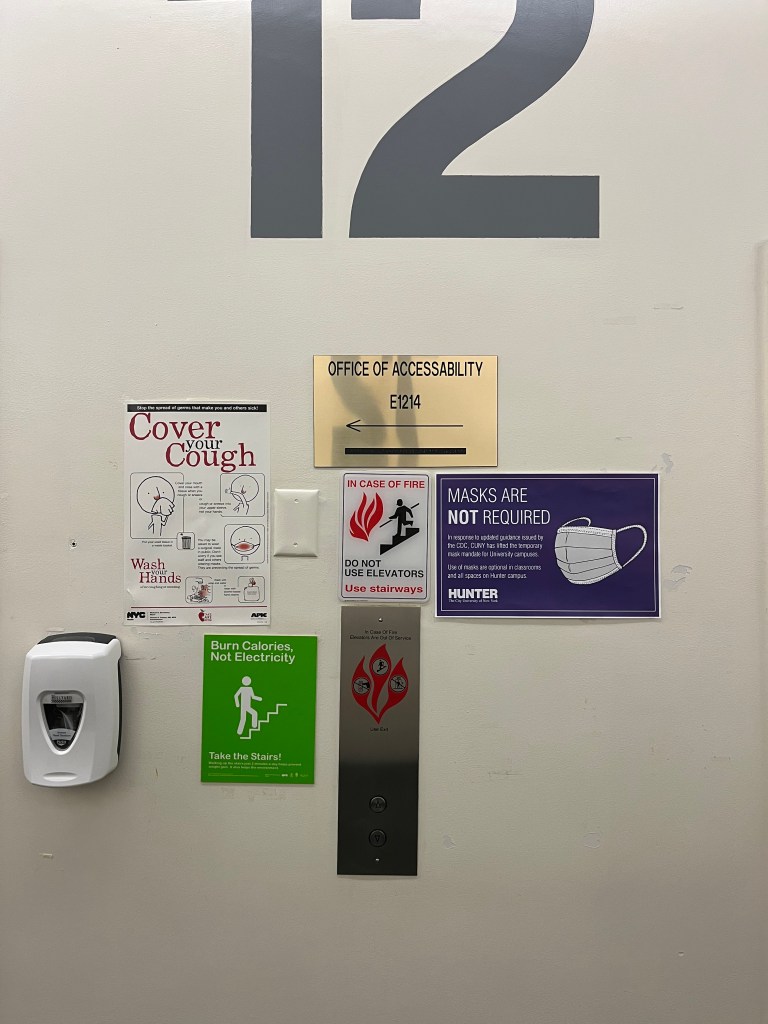
As stated on their website, the purpose of the Office of Accessibility is to “enhance the educational experience for students with disabilities at Hunter College” by providing services that create an accessible education. Some of these services include testing accommodations, interpreters for deaf and hard of hearing students, note-taking services and adaptive technologies for students with learning disabilities, visual and hearing impairments.
To access these services, you must provide medical documentation to verify your diagnosis, which for me, took a few months longer than I anticipated because it took a long time to secure a dermatologist appointment. Without recognition by the office, I had to cross my fingers and hope that my professors would be compassionate to my situation.
While some professors were kind and offered flexibility regarding deadlines and attendance, this was not the case for all of my professors. Though I tried to keep up with the pace of my classes by regularly meeting with professors and obtaining notes from students, I was still met with stigmatizing messages about my disability and inflexibility regarding deadlines and attendance policies.
On several occasions, professors told me to drop out of school and to come back when I was feeling “better.” In another instance, a professor requested that I send pictures of my skin as “proof” of my condition. I did not send pictures and I later learned through the Office of Accessibility that I did not have to disclose my disability to professors.
One professor’s attendance policy was so strict that I had been on track to fail the course despite handing in all of my assignments on time. I dropped the course.
These strict requirements and ableist rhetoric display a lack of awareness towards the reality of living with a disability. Disability is not a fleeting illness. It is a long-term – and for some, a life-long – condition.
When a professor suggests that a student should return to school once they feel “better,” they imply that you can only look and feel one way to be in school. They suggest that to be a student worthy of receiving an education, you must have an able body and a neurotypical mind.
After I was registered with the Office of Accessibility, I noticed that professors were less likely to ask me inappropriate questions regarding my disability. However, to my disappointment, much of the treatment remained the same. It was still mostly up to the discretion of my professors how accommodating or flexible they would be. Professors were not held accountable for rigid standards so long as they were listed under the class policies within their syllabi.
The Office of Accessibility expresses the right of each student to “not be denied access to programs and services” on the basis of their disability and requires that professors integrate accessibility into the planning process of their courses.
Yet it was on me to weave through professors’ past syllabi, assuming I could find it, and converse with other students about whether the course was actually accessible to its students.
The result is that many professors get away with ableist class policies and students with disabilities must sacrifice classes they were eager to take in order to protect themselves from unaccommodating professors.
Though my registration with the Office of Accessibility afforded me accommodations I would have otherwise not received, it also showed me its limitations.
Apart from this realization, whether one receives recognition by the Office of Accessibility should not determine whether they receive accommodations for their disability. Not all people with a disability or chronic illness receive a diagnosis in time. It can take months (even years) to identify your symptoms and have a medical professional properly diagnose your condition.
Being a student overloaded with deadlines and lacking health care insurance for specialized care can make the process even more time-consuming, expensive and disheartening. By making it so difficult to prove you’re disabled, Hunter leaves students who need special accommodations unsupported.
When COVID-19 hit in the spring of 2020, Hunter College abruptly transitioned to remote learning, presenting new realities for students with disabilities. The way we learned transformed entirely, and schools finally implemented what disability justice advocates have been fighting for for years — virtual learning models.
For students with disabilities or chronic illnesses, virtual learning is a mixed bag. I know that for many, Zoom learning negatively impacts their mental health and ability to focus. But for others (me included), being able to learn from home was a massive sigh of relief.
There were days that had the class been in-person, I could not have shown up, but Zoom allowed me to learn from anywhere in my home, with the camera off if necessary. It was incredibly healing for my mental and physical health.
So when Hunter reopened for the fall, I was curious to see how this would impact the fate of students with disabilities. Many of us who benefitted from virtual learning were either seeking to continue remote learning or opt into a hybrid learning model.
Hunter’s plan included 30% in-person, 35% hybrid, and 35% online classes. I was able to enroll in one hybrid and one remote class last semester, which helped.
But in-person classes were strictly in-person. Most requests I made for flexibility to learn from home when I needed were denied. Professors seemed to be exhausted by Zoom learning and their eagerness to abandon it left students who benefitted from it behind.
An accessible learning model is not achieved by simply dividing up classes into in-person, hybrid, and online categories. Rather, it is achieved when accessibility becomes a fundamental component to how all classes are structured, which would enable students of varying needs to share space in an inclusive learning environment.
I know that given the adaptations to student learning made in the last year or so, a new learning model is possible.
Some professors are unwilling to change old habits, giving in to the common narrative that learning from home is overwhelmingly distracting and burdensome for most students. But I would argue that it affords students the flexibility they always needed. In virtual learning spaces, I noticed parents holding their infants in their laps during class, students taking care of family members and students propped up with five pillows and their cat on the couch.
In the comments section of my Facebook post, a student said, “I hate that, now that in-person classes are going to be starting up for me again soon, I will likely have to, when I’m having bad fibromyalgia flare-ups, choose between skipping class or having to use large amounts of my medical marijuana to get to class, where I know I wouldn’t be able to concentrate.”
They separately stated that in times when they are not experiencing a flare-up, in-person classes “make my mental health better.”
These are the kinds of perspectives we need to elevate when discussing accessible learning models. Students with disabilities and chronic illness should not have to make an either-or decision regarding in-person or online classes if whether they benefit from one or the other depends on the day.
It is clear that Hunter’s end goal is to leave hybrid or online learning behind. While the fall 2021 model included 30% of classes in-person, most classes this spring semester are being held in person.
However, accessible learning models would be life-changing for students and professors. Perhaps if students knew that their education could take a different shape than the one that they’ve always known, they wouldn’t feel so daunted in seeking higher education. They would know that their education could adapt to their life and not the other way around. The quality of learning would improve for all and students would feel their education to be worthwhile and enjoyable rather than a series of roadblocks to the finish line.
These models must be implemented with comprehensive disability training for professors, which can help address ableist rhetoric and promote values of compassion and flexibility.
It is especially crucial to advocate for these measures now when professors and students have become adept at hybrid and online learning, and the benefits of these models are more felt by students and professors.
As another student wisely wrote in the comments: “Accessibility isn’t something that should be tacked on as an afterthought once the semester starts; it should be a fundamental consideration in how all classes are developed and structured (and from which everyone, not just those who identify as disabled, will absolutely benefit).”
Let’s change accessibility at Hunter from being a second thought to a foundational aspect of how all classes are structured.

 The Envoy
Leave a Reply