
A group of about 15 students gathered in a lounge one afternoon this semester for one of the Queer Student Union’s “Tea Sessions.” In previous sessions, they’ve talked about coming out, pronouns, labels, and religion. This one was focused on asexuality and bisexuality.
At the entrance of the lounge is a table stocked with Capri Sun juice pouches and cookies. A few more students wander in as the conversation gets rolling, and a handful of the students start to connect over how they realized they were bisexual and dealt with other people’s reactions to coming out as that identity.
The Queer Student Union (QSU) is a club that hosts events for the queer community on campus and provides LGBTQ Hunter students with a “third place,” a concept in sociology for a space where someone can relax and socialize away from the two primary places: their home and work.

The QSU disbanded in 2020 amidst the pandemic and wasn’t revitalized until the 2023 fall semester.
“People have been ready and waiting for an opportunity to be a part of the community again,” said Rachel Parsley, the club coordinator.
Recently, the QSU collaborated with Hunter’s chapter of YDSA to host a gender-affirming clothing swap/thrifting event where no cash was exchanged to commemorate Transgender Day of Visibility.
Parsley said there’s a difference between knowing there are a lot of queer students on campus and actually having the opportunity to connect with them.
“It’s not like you can walk up to people, and be like ‘Are you gay?’” Parsley said. “This is a space where you don’t have to out yourself or be the most flamboyant.”
Litzy Antonio, the club president, led the revitalization efforts and said the events are an escape from the stress of daily life.
“That reality is harsh sometimes,” Antonio said.
Studies have revealed that LGBTQ+ individuals are more likely to face financial hardship than their cisgender heterosexual counterparts, and a study from 2020 found that almost half of CUNY students came from a family that earns under $20,000.
Parsley said the QSU events allow students to see that being queer is about more than just the struggles the community faces.
“A lot of our events are all about queer joy and bringing in positivity because a lot of the narratives that we see in media are constantly toxic,” Parsley said. “We do a lot of work, educating and memorializing and talking about the negatives and the uncomfortable parts of having a queer identity, but we also want to make sure that people know that it goes beyond that.”
In February, the QSU collaborated with the Asian Student Union and Black Student Union to host a Valentine’s Day Mixer event. Antonio said there would also be a food drive and some pride events featuring drag and tie-dye in April. The group has to celebrate pride two months early since it takes place over summer break.
They hope to collaborate on an event with the LGBTQ Policy Center, a branch of the Roosevelt House Public Policy Institute that focuses on expanding educational opportunities, research and legislation for the LGBTQ+ community.
Avidor Auden, an anthropology major in their junior year, prefers to spend a lot of their time on campus at the Hillel club room. He said as a Jewish student, it’s “easier to have a community” since other regulars congregate there.
For Auden, the permanency of the space makes it easier for busy students to find familiar faces since they can drop in whenever they have time for it.

The QSU doesn’t have a club room where students can spontaneously stop in. Auden is also queer, and said if there were a permanent space similar to the Hillel where LGBTQ students could hang out and study together, she “would absolutely go.”
“I’m not really looking at Hunter right now,” said Auden about third places. “Honestly, I’m mostly waiting to turn 21 to check out some of the historical dyke and queer bars.”
The number of accessible third places for LGBTQ students in New York is increasingly limited due to the closure of lesbian and gay bars, reduced hours of public libraries, loitering laws, discrimination, hostile architecture, privatized parks, and more.
Auden said the LGBTQ community at Hunter is so diverse that it can be hard to find someone you closely connect with.
“You’re both queer, and that’s where the similarities end,” said Auden. “I feel like … I’m supposed to have a lot in common with somebody else who’s queer, but I often don’t.”
Another safe space available to students is the CUNY LGBTQI+ Consortium which hosts events that are open to the LGBTQ community across all of the CUNY campuses.
Recently, they participated in the St. Pat’s For All Parade in Queens and marched with the New York City Public Advocate, Jumaane Williams.
Before the parade started, the group was visited by filmmaker and LGBTQ+ activist Brendan Fay, who spoke about why he started the event.
“We began in 1991 when the Irish gay/lesbian immigrants asked to march in the Saint Patrick’s parade and we were told ‘you are not welcome. No queers, no gays allowed,’” Fay said to the consortium.
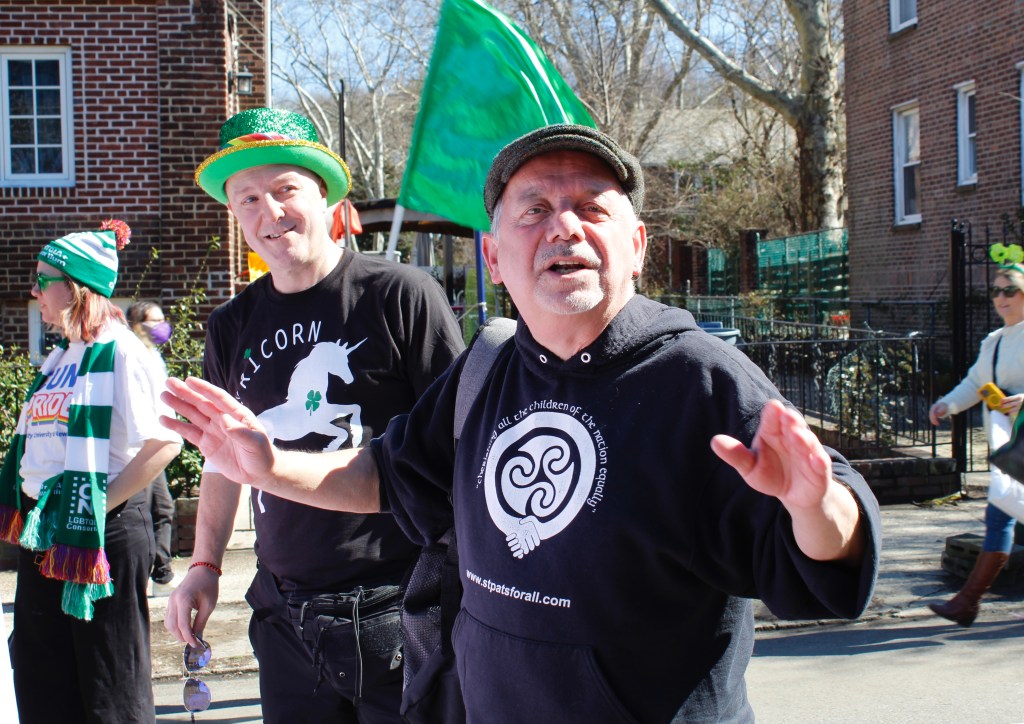
He said that year after year he tried different boroughs but was always arrested for participating in the historically Catholic Irish event.
LGBTQ groups were officially allowed to participate in the annual Manhattan parade starting in 2014, but “organizers of the parade on Staten Island have insisted that gay groups do not belong at an event for a Catholic saint,” according to a recent New York Times article.
“I came home and I said to my partner ‘Tom, I’m going to apply for a police permit and create a parade that will have a spirit of genuine, radical hospitality and inclusion at its heart.’”
Footage of Brendan Fay speaking to the CUNY LGBTQIA+ Consortium.
This year marked the 24th St. Pat’s For All Parade. Several politicians spoke at the event, including Alexandria Ocasio Cortez.
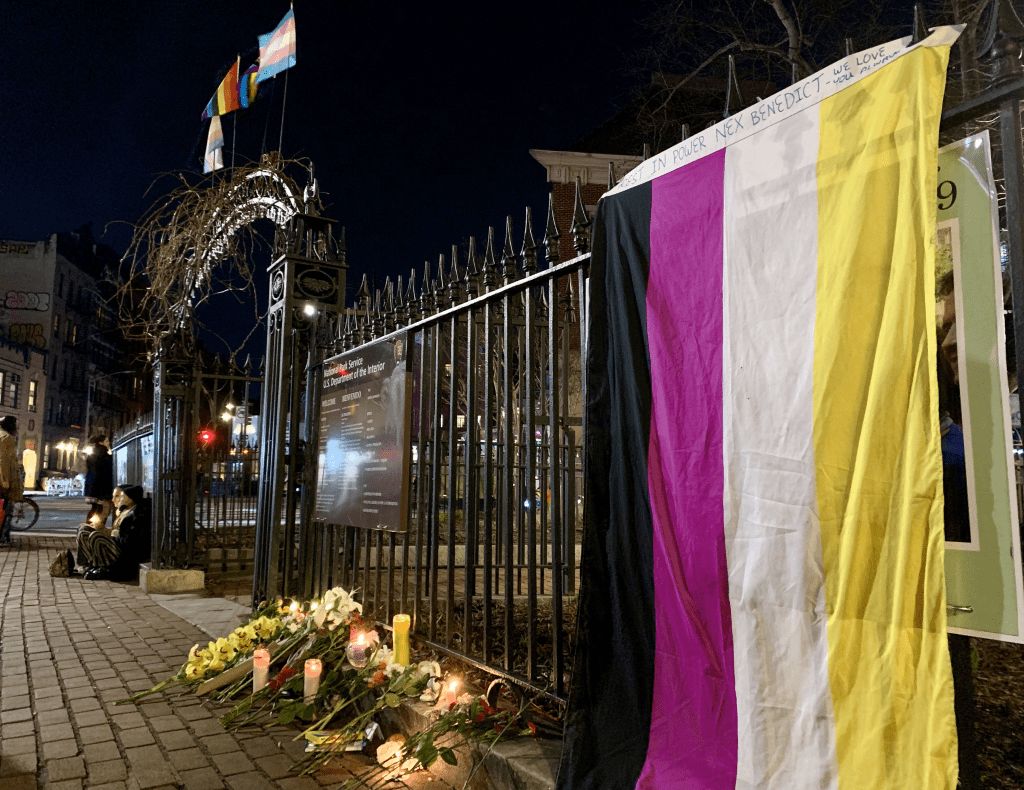
The bright sun, cheerful shouts, and smiling faces at the parade were a stark contrast from the vigil on Feb. 26 outside of the Stonewall Inn, a historic gay bar in New York, to commemorate Nex Benedict, a non-binary student from Oklahoma who died on Feb. 8, the day after three other students allegedly assaulted him in a school bathroom.
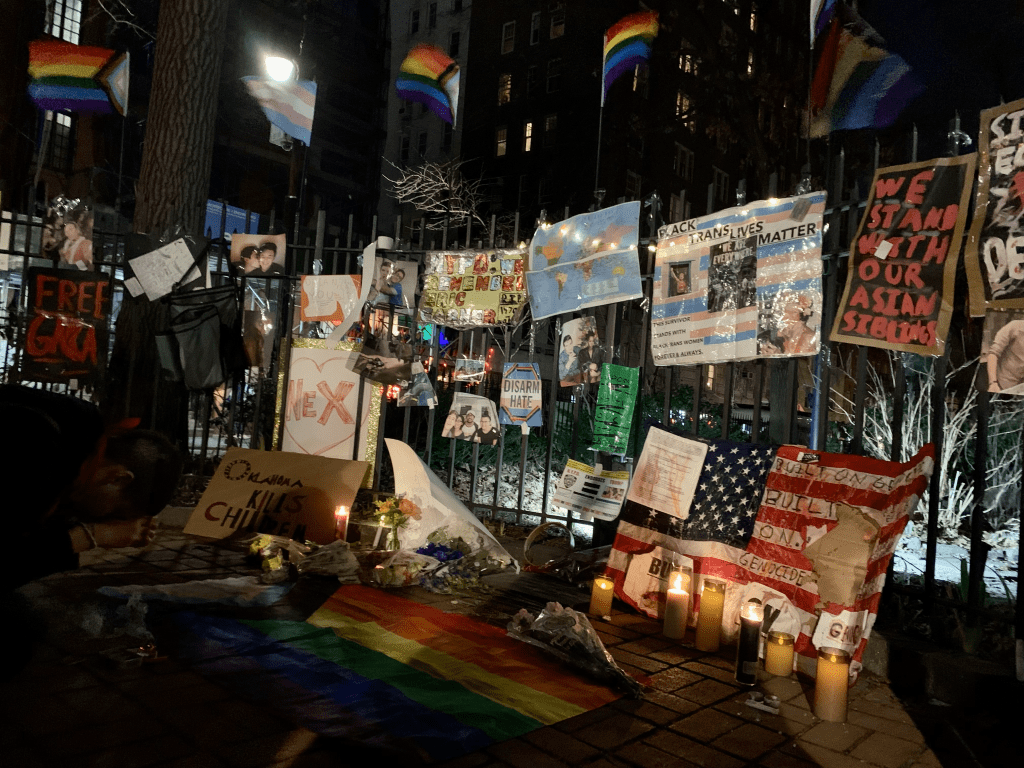
That evening several speakers condemned the “infrastructure of anti-trans hate,” naming legislators and media personalities who’ve amplified transphobic rhetoric and policies.
Amid the angry and grief-stricken speeches, were also declarations of love and support.
“It is our moral and humanitarian obligation to speak up, show up, and take action against the anti-trans machine,” said actor and activist Sara Ramirez to the crowd. “To all of our trans, non-binary and queer youth, I want to say I love you and I will always f—ing love you.”
Parsley said that in the face of these tragedies, the QSU tries to be a safe space for queer Hunter students.
“We’re very fortunate to be in such a diverse, open-minded and leftist state and city, but that still doesn’t stop some of this negativity and really painful trauma from coming in,” said Parsley. “We can just do our best to provide people with a space where they feel celebrated.”
 The Envoy
Leave a Reply