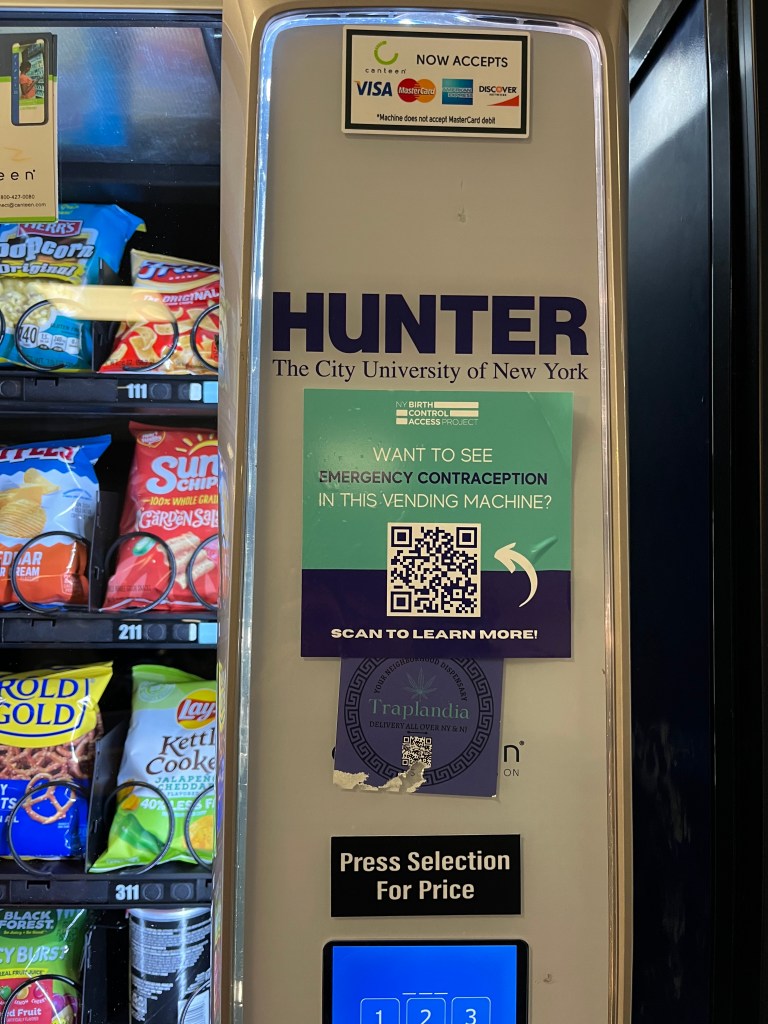
Addressed to The Envoy, several Hunter College students who are members of the New York Birth Control Access Project, an organization that advocates for reproductive health and pro-choice legislation within the state, wrote letters expressing the need for emergency contraception accessibility across CUNY (and New York) campuses.
The following letter was written by Melody Garcia, an Associate Board Member for the New York Birth Control Access Project.
“Take whatever you need. I won’t look,” the girl shouted behind a table display from Hunter College’s Purple PEERiod Project, before putting her hands over her eyes.
A spread of pink packages containing hygiene products greeted us: pads, tampons and condoms. Hesitantly, I reached for a package while noticing others nervously doing the same double take. I didn’t get a good look at most of the people who partook, but I recall a student who appeared disappointed that the additional supply of condoms on the table rapidly went out of stock.
Despite my gratitude to programs like these, as finding menstrual and sexual hygiene products at Hunter can be a bit sporadic, the Purple PEERiod Project shows up only on Tuesdays from 12 to 1 pm, and by the time I tend to get there after class they’ve already run out.
Because of these difficulties that I faced, I joined the Spring 2024 cohort of the New York Birth Control Access Project (NYBCAP), where my fellow Hunter peers and I sought to expand access to these products at our college and other New York campuses.
Our main focus is to enshrine the availability of over-the-counter emergency contraceptives on campus. Emergency contraceptives, like Plan B One-Step, help prevent pregnancy before it begins. It is typically taken after the first use of birth control was failed, forgotten or forgone, in turn delaying ovulation.
Where, you might ask, shall we find them? The answer: in our vending machines.
Among all the things we need as students, Hunter provides the majority of it. It’s got a gym, a swimming pool, a park, a library, and even an art gallery; it is not just the sum of all its parts, but something bigger. A campus is a community space, one where we should be able to access the things we need to thrive in that community. So why not make the place where you can get a charger if you forgot it become a place where you can get birth control when you need it? If we can already get condoms at the USG office, why not go one step further for our healthcare needs?
Just as vending machines bring us an assortment of snacks and drinks at the touch of a button, it’s all about convenience. A walk to the nearest deli is less than a block away, but why get up and go outside to swipe your ID in again when you can get your soda around the hall? Neither does anyone prefer to stand in line at a pharmacy with emergency contraception in hand while other customers surround you. No lines. Available as long as the campus is open. In lieu of an on-campus health center, this could provide students with an easy and affordable ($10) way to contraception.
If you’ve been to some of the other CUNY campuses, you may have seen these emergency contraceptive vending machines over at John Jay— the first CUNY campus to install them— as of last December.
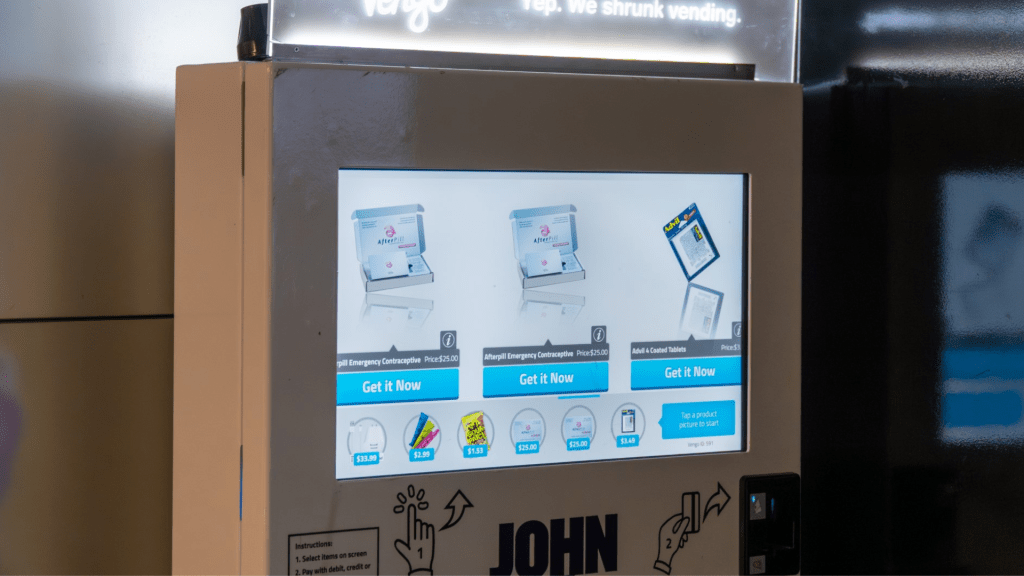
SUNY Upstate Medical University secured a spot for these emergency contraception vending machines in March through the invaluable efforts of students Serena Schmitt and Olivia Preston, who collaborated with the New York Birth Control Access coalition to install the first machine at a SUNY. After learning that emergency contraception was not always affordable nor available the two students created the Student Wellness Vending Machine where Levonorgestrel (also known as Plan B) would be available for $10 and located in the library where students have 24 hour access.
Currently, a bill introduced to the New York State legislature, S4400/A4091, would require these vending machines to be installed at every CUNY and SUNY campus. Sponsored by Senator Lea Webb and Assemblymember Jessica González-Rojas and Senator respectively in early 2023, these vending machines would provide contraception at a price that wouldn’t exceed forty dollars. Placing these vending machines would be one of many avenues for equal and affordable access to healthcare for all communities, especially working-class students like us. However, both are currently ‘stuck in committee,’ meaning the committees in charge of hearing them (in this case, the Higher Education Committees of the Assembly and the Senate) have not yet reached an agreement and have yet to advance the bill.
As I went around petitioning in February, I received a lot more enthusiastic “yeses” than “no’s.” Some even handed the petition to their friends, saying “Sign this,” without my urging. Other students inquired about further strides, such as whether these machines would also supply menstrual products like pads and tampons.
From what we have intended, each vending machine (placed alongside regular snack machines) would come stacked with the aforementioned emergency contraceptives, menstrual products, and condoms, among other things.
I was astounded by the passion from students who wanted to join the cause as well. I directed them to the New York Birth Control Access Project, which is always taking applicants for the Associate Board, where many learn about methods of birth control and its’ importance.

Other avenues include joining the Planned Parenthood Generation Action, a network for students to mobilize on their campuses for reproductive access, as well as the Advocates for Youth, a group similarly dedicated to uplifting youth voices, who ran a campaign to make the birth control pill, Opill, affordable and approved for sale without age restrictions. They won in 2023 and provide a great model for demonstrating what can be done.
Taking action for a cause does not always mean being out on the front lines, but also includes sending letters to your local politicians to urge them to sign a bill ( such as S7860/A4091), or writing out to your campus administration to implore changes on campus.
The EC for Every Campus network also offers information about emergency contraceptive vending machines or the facilitation of peer-to-peer emergency contraceptive distribution, which led me to join this New York-specific project. Starting a passion project is exactly what the SUNY Upstate Medical students did, and they were approved and funded. While change takes time, everyone has the unwavering potential to take actionable strides.
As a Catholic, some may assume that I’m against this sort of stuff, but in all opposite, I have come to fully embrace it. The complicated and the unexpected are a part of life. I have come to love people for all of what they are, wholeheartedly. The path, the journey, and the choices are all made out to be the way they are. Gynecology is humanity’s greatest invention, after all.
Letting someone choose when or when not to be pregnant sets right in loving them and even loving what could have been, and that is what I declare faithful to knowing and embodying love. You know what’s best for you (and sometimes others) in your situation right now.
As humans, with all our curiosity and agency, we should be fully empowered to make that choice. Love is too complicated, and so too is the world, to fit into labels. Just as I can be queer, pro-choice, and Catholic, you don’t have to follow a doctrine, and dogmas can be misinterpreted or subject to change.
That’s why I’m advocating for a judgment-free place to pick up the things you may need. We could never guess when and where things happen. It’s never any of our business to the sex lives of adult college students, staff, or anybody who may need it. However, it is our concern and responsibility to make it easily accessible and affordable when these things happen.
When we grow and move on, we hope to leave things better than they were before, for not just our generation but for the next. As I leave Hunter now as a graduate, I want to see it easier for those still on their college journey or those who will come next. It comes with the ability to choose, to make your own destiny, because, though we do not see the path ahead, whatever happens is what is meant to be.
The following letter was written by Janata Harrison, an Associate Board Member for the New York Birth Control Access Project.
Over 1.2 million women in New York state live in a contraceptive desert and for those with access, emergency contraception can cost up to $60 at the pharmacy. Across the state, SUNY and CUNY campuses have the opportunity to place wellness machines with affordable emergency contraception sold for $10. These vending machines can sell emergency contraceptives, menstrual products, condoms, and more health items that our community desperately needs. With our campus being open 18 hours a day, every day of the week, these vending machines would be more accessible than pharmacies or health care providers.
Food insecurity within our Hunter community serves as a significant indicator of a broader problem we are struggling with. By expanding access to affordable contraception where people need it and when they need it, Hunter can address one financial burden that students face when buying expensive emergency contraception off the shelf. Students at Hunter would be able to access emergency contraceptives on our own terms, without judgment or worry. In a college that boasts a majority female student body, the availability of over-the-counter emergency contraceptives in vending machines is needed now more than ever to improve access to essential health care resources within our community.
The following letter was written by Elee Ballinger, an Associate Board Member for the New York Birth Control Access Project.
A lot of college students in New York City are living with family, so they might not have the ability to get to a pharmacy and discreetly acquire contraception. If emergency contraception, and other necessities such as menstrual products and condoms, are available in vending machines on college campuses, people will be able to access them conveniently, anonymously, and affordably. I have purchased pregnancy tests for my friends before, so the charge wouldn’t show up in their records. There are no age restrictions, nor is a prescription required to get emergency contraception in New York. It’s as safe as Tylenol. With the rampant misinformation and stigma around emergency contraception, providing it in vending machines on college campuses, in transit systems, and other public places will empower people and increase access to quality healthcare for all communities.
More information on the New York Birth Control Access Project can be found here.

 The Envoy
Leave a Reply