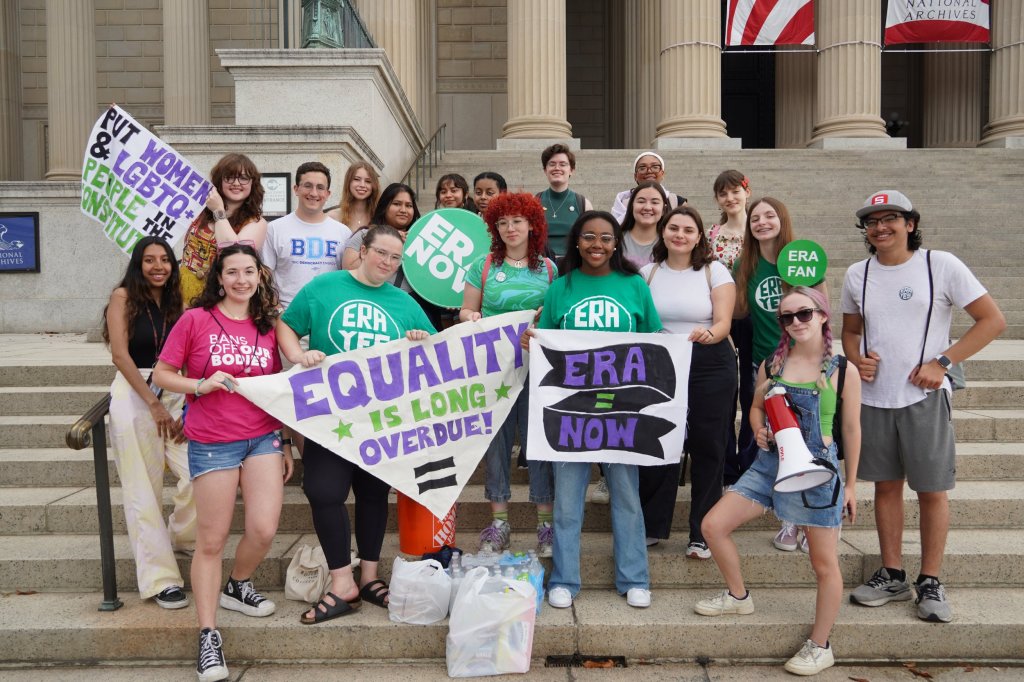
New Yorkers will vote on a proposal aimed to codify reproductive and LGTBQ+ rights on Nov. 5.
The proposal, also referred to as the “Equal Rights Amendment,” aims to add language banning discrimination based on age, disability, sex, gender identity, pregnancy, and reproductive status to the New York State Bill of Rights. New York is one of 10 states to feature a similar ballot proposal on election day.
Article 1 Section 11 of the Bill of Rights already protects “against unequal treatment based on race, color, creed, and religion,” but if the additional language is ratified, New York will be the most inclusive out of 22 states who have an ERA.
The push to secure abortion rights arose from the 2022 Supreme Court decision to overrule Roe V. Wade, eliminating the constitutional right to an abortion. Since then, 13 states have full abortion bans while 8 have restrictions. In New York, abortion is legal, but not codified. Despite being legal since 1970, it was only decriminalized in 2019.
Who is in favor?
New Yorkers for Equal Rights, a coalition of over 500 civil and reproductive rights organizations, is spearheading the advocacy work for the NY ERA. The campaign has spent over $3.5 Million on the campaign in favor of its ratification. Over $1.8 Million of the funds were donated by the New York Civil Liberties Union, with the rest coming from Planned Parenthood and other organizations.
The state legislature passed a vote during a special session on July 1, 2022 as a direct response to the Supreme Court decision. It was sponsored by Senator Liz Krueger and Assembly Member Rebecca Seawright.
But enshrining reproductive rights does not guarantee access, says Isabella Grullon, a fellow at NY Birth Control Access Project, a non-profit organization teaching students how to advocate for reproductive justice. Grullon describes the resources provided to fellows as “having professionals coming to teach them how to organize, speak with press and talk to legislators.”
“We still have barriers,” Grullon says. “Racial and equity barriers and there’s more that could be done.”
Organizations that currently do work to support the federal initiative for an Equal Rights Amendment, such as the Young Feminist Party, believe that the passage of the New York ERA could be a monumental step in the journey for constitutional equality nationwide.
Belan Yeshigeta, Columbia University junior and co-founder of the Young Feminist Party, says that the explicit support of abortion in the New York’s ERA “is the kind of language we need in future state ERAs,” and is the needed push for New Yorkers to go to the polls this Tuesday.
“We’re in a very, historical and devastating moment, both within our country and, internationally,” Yeshigeta says. “And I think a lot of people are hesitant about whether or not they vote. What I really appreciate about these ballot initiatives is that they’re showing people that there is still a reason to show out.”
Who is opposed?
The amendment is officially opposed by the New York State Republican Committee. In May, Republican Assemblywoman Marjorie Byrnes temporarily succeeded in tossing the amendment over procedural semantics. It was restored a month later by the court of appeals because the lawsuit missed their deadline under a four-month statute of limitations.

Coalition to Protect Kids NYC, a ballot issue committee, has spent over $320,000 in opposition of Prop 1. The only donation listed publicly is $290,000 from Carol Crossed, an anti-war feminist activist in the 1970s. She shifted her sights to abortion after Roe V. Wade showed her “pro-life and anti-nuke folks belonged together.”
The Coalition to Protect Kids NYC website, which calls the amendment the “Parent Replacement Act,” claims it will allow biological males “a permanent right to compete on girls teams” and “schools could be banned from disclosing to parents that their children are becoming transgender.”
According to an analysis by a committee at the New York City Bar Association, both claims are not true.
“Prop 1 does not change existing law with respect to parental consent, or parents’ ability to be involved in decision-making… including gender-affirming care,” said the committee in a statement posted on the website.
These claims are pulled from a 2023 memo from the New York State Department of Education on the best practices for transgender students.
Andrew Taverrite, the communications director for New Yorkers for Equal Rights, believes the opposition is using “a handful of kids as political pawns to divide New Yorkers and distract from what Prop 1 is actually about: protecting the right to abortion and preventing discrimination.”
“Prop 1 does not change current law. In New York—as is the case everywhere in the country—state law does not allow minors to receive gender-affirming medical care without their parents’ consent, and Prop 1 doesn’t change that,” he says.
Empire Center, a physically conservative think tank, is afraid that “vague language” could lead to an onslaught of new legal challenges that will “place decisions on civil rights policy in the hands of the judiciary and not the legislature where they belong.”
Will it pass?
According to a Siena poll published on Sept. 19, Prop 1 has a 78% approval rate in New York City, and 60% support in the rest of the state.
Erin Mayo Adams, an assistant professor in the Political Science Department and the Human Rights Program at Hunter College, expects there to be legal challenges if it passes, “which is what usually happens with these initiatives, but it’s likely to survive that.”
“Symbolically, it’s really going to matter to all the groups that are impacted by it,” Adams says. “And it’s going to solidify what New York wants to be.”

 The Envoy
Leave a Reply