Students held a sit-in at the Thomas Hunter building to demand the immediate removal of dance professors accused of teaching discriminatory curriculums on Monday, Oct.24.

Together, students, faculty and alumni listened to open critique and protest of Dance Professor Lori Brungard’s “Global Dance History” course. This marked the second student-led sit-in organized this semester, as part of a weeks-long effort to get Professor Brungard removed. Hunter’s Chair of Dance Paul Dennis, MFA Director Maura Nguyen Donohue and Professor Brungard were all present. Several other faculty members also joined and sat amongst the swarm of students who lined the hallways of the sixth floor.
Students claimed that despite the presence of “global” in the course title, Brungard primarily teaches ballet in the class, a dance style that originates from Europe. Her syllabus for the course, obtained by The Envoy, dedicates at least six weeks to studying ballet. On the contrary, it dedicates three weeks to studying dance from East Asia, the Middle East and Africa.
Students argued that while Brungard offered a detailed explanation of the history of ballet and its techniques, she did not provide the same level of detail and attention when teaching other dance forms. At the sit-in, students specifically critiqued Brungard’s “African Diaspora” lesson, in which Brungard focused on dance styles originating from slavery.
“She referred to African people as ‘those,’” said Jenna Pelusio, a junior majoring in Dance and Psychology, and a student in Brungard’s class. To the crowd sitting in, Pelusio read from the petition for Brungard’s termination.
“[She] referred to Africans who were kidnapped and enslaved as ‘imports’ and referred to the transatlantic slave trade as ‘convenient,’” said Pelusio. “In a joking manner, Laura [Lori] Brungard asked, ‘why would you want to abolish slavery?’”
Brungard remained silent.
The organizers passed around photocopies of Brungard’s presentation slides for attendees to view.
One slide states, “[the] transatlantic slave trade brought African music and culture to the US.”

Another slide describes the dances performed in minstrel shows, a form of racist theatrical entertainment in which white people would perform different dances to mock people of African descent. The slide refers to Black people in a derogatory manner.
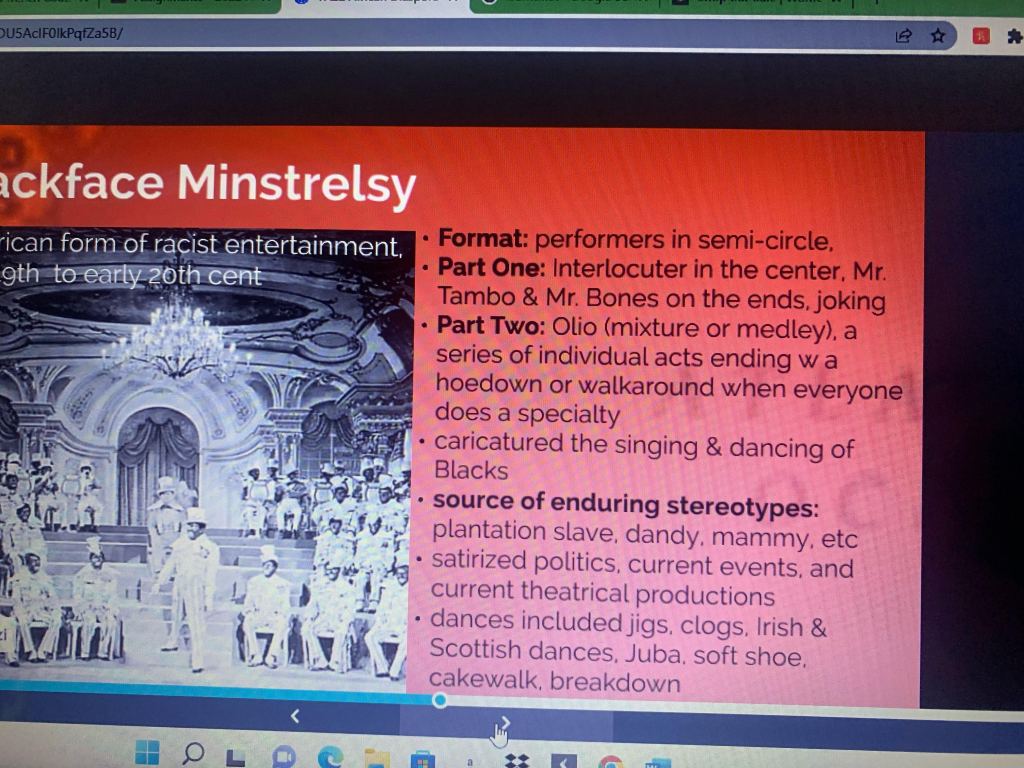
The summary slide states, “the transatlantic slave trade introduced African dance elements into the American mix.”

Students directed questions at Brungard.
“Do you feel like you’re qualified to teach a global history class?” said Jalisa Wallerson, a dance major and student in Brungard’s class.
“With the term global in it? No,” Brungard responded. “One of the reasons why the content is more eurocentric or too eurocentric, however you want to describe it, is because that’s the material that I know the best.”
“I really do want to learn,” she said.
Prior to the sit-in, Brungard emailed her class asking for students to collaborate with her in redesigning the class curriculum. Some felt that this effort placed unfair responsibility on the students.
“If you don’t know about it, you shouldn’t be teaching the class!” said Wallerson.
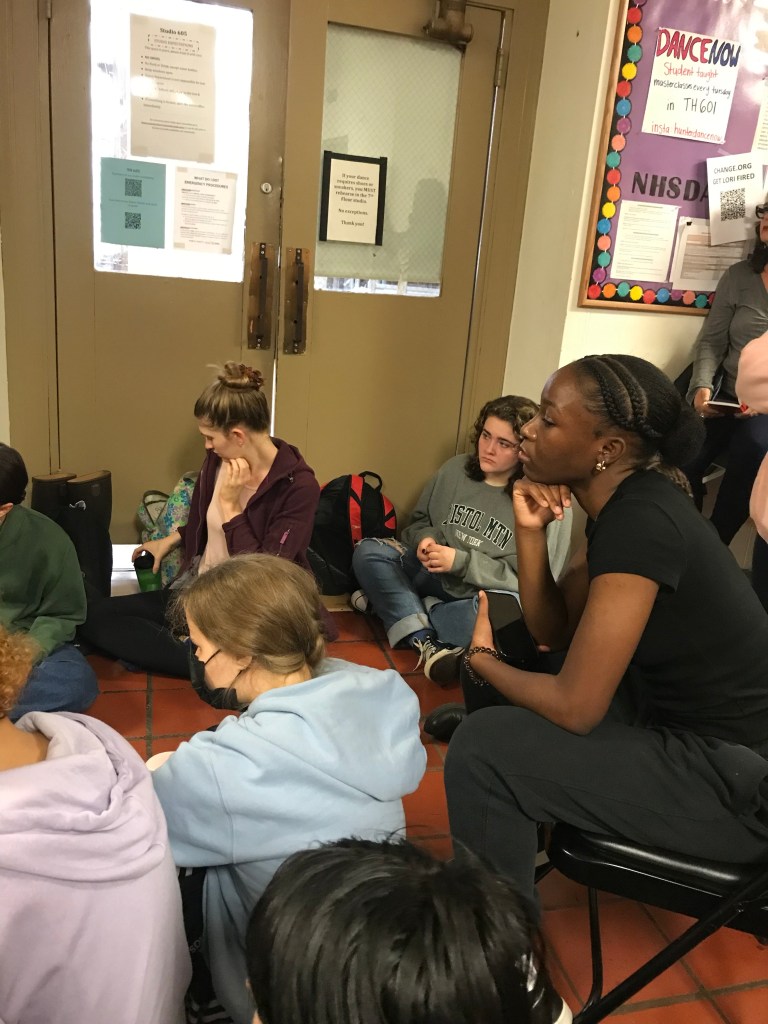
“Do you understand why the lesson that you taught on the African diaspora was wrong?” said Olivia Jones, a freshman studying Dance.
“I didn’t understand until now that you said it,” Brungard said.
“I mean, referring to the slave trade, as just bringing music and African culture over,” Jones said. “It brought African people over. Against their will! That is a lot of people’s ancestry. Sorry for getting angry.”
“Don’t apologize,” students responded.
“So many people died because of that,” Jones continued, her voice starting to quiver. “I don’t know what my history is. Because it was all erased. Because my family came from slaves. That’s not – I don’t like – do you understand that’s not okay?” Jones said.
“I do,” Brungard murmured.
“I’m sorry for yelling,” Jones said. Students protested her apology and she started to cry.
“We are people. Okay? Not ‘imports.’ Not ‘those,’” Jones said. A student pulled her into a hug. Clapping ensued.
The department chair admitted that he did not know how or why Brungard came to teach Global Dance History. Dennis said that he would try to figure this out.
“I am sorry that you’ve had to endure egregious teaching,” Dennis said. “It stops with me. I’m sorry that you’ve had to endure not being heard.”
Students also demanded the removal of Ana Fragoso, the Director of the Arnhold Graduate Dance Education Program. They critiqued Fragoso for teaching a unit that encourages students to re-enact the actions of enslaved people.
To her “Methods of Teaching Dance II” class, Fragoso presented a lesson that she taught to fourth graders for several years called, “Bringing History to Life Through Dance: The Underground Railroad.”
The unit aims to prepare students to choreograph a dance based on the history of slavery. Lesson one of the unit includes a list of dance vocabulary, including “clean” “scrub” and “pick cotton.” Lesson two requires students to create a scene that would re-enact enslaved people crossing a river on their journey to freedom.
At the sit-in, Fragoso offered an apology.
“I am deeply sorry for the harm that has been caused to my students,” Fragoso said. “My students have been suffering all of this time because I have taught that unit.”
Students continue to demand the removal of Professor Brungard, as well as Director Fragoso, and they call for the hiring of new educators who can teach diverse styles of dance.
Hunter College’s administration and dance department did not respond to a request for comment.



Leave a Reply