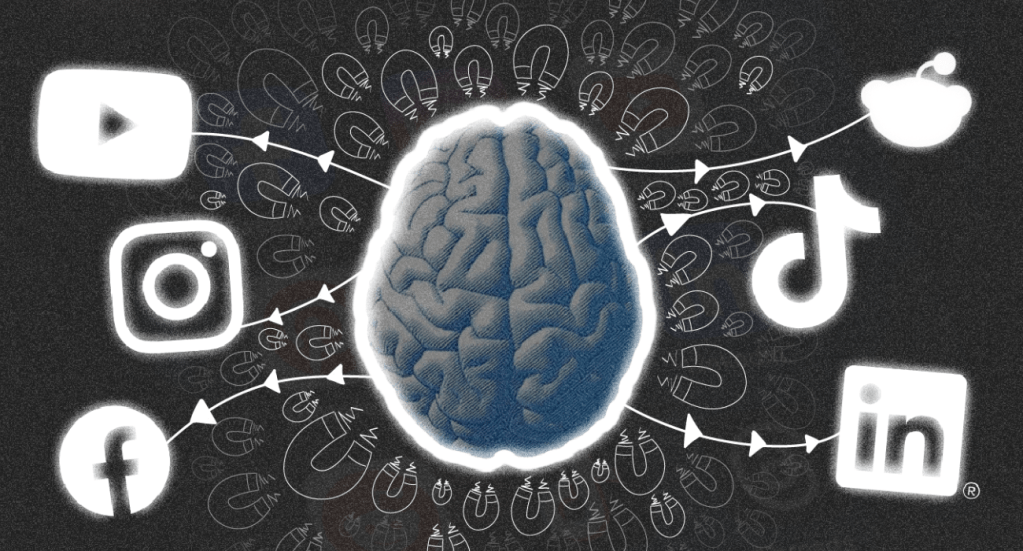
Every day, hundreds of voices from people we’ve never met enter our minds. We listen and respond to these voices—often resulting in lively debates—without ever being fully conscious of them.
With so many voices sounding off, it becomes difficult to discern whose is truly our own. Unlike pre-modern humans, whose internal dialogue consisted primarily of conversations with ‘real’ people like friends and family, today’s smartphone user is inundated with the voices of a myriad of strangers. With virtually everyone around the globe consuming multiple hours of social media content daily, the quantity and volume of external voices we take in are at an all-time high.
In 2007, acclaimed essayist George Saunders published a uniquely prescient piece on how the pervasiveness of high-tech media oppresses society and the individual.
In “The Braindead Megaphone,” Saunders describes a party attended by guests from all walks of life. People are enjoying themselves, talking about subjects that interest them personally, and exchanging ideas. Then, all of a sudden, a guy (a very stupid guy) with a megaphone bursts in. Every time he yells through the megaphone, all other conversation halts, and everyone turns their attention to his idiotic rants.
When he finally stops, everyone else begins talking amongst themselves about what ‘Megaphone Guy” just said—whether or not they agree with his statements and whether his ideas deserve any credence. Megaphone Guy must keep their attention, or the guests will eventually tune him out, so he makes outlandish, uninformed statements and tells incredible stories that are not exactly based in fact.
In the end, Megaphone Guy ruins the party, deciding what everyone discusses and placing an “intelligence-ceiling” on the party’s conversations. The guests are stripped of their own thoughts and reduced to mere reactors to Megaphone Guy’s blaring voice.
In this allegory, the ‘Megaphone’ is “the composite of the hundreds of voices we hear each day that come to us from people we don’t know, via high-tech sources.” However, the most prominent high-tech source is no longer cable TV (as it was when Saunders wrote his piece in the mid-2000’s), but something with far more power and reach: smartphones and social media. The voice emanating through today’s Megaphone is that of online content, and the modern ‘Megaphone Guy’ is ‘The Algorithm.’
Marshall McLuhan, known as the “father of media studies,” invented the infamous phrase: “The medium is the message.” Meaning the mediums through which we consume content are far more substantial and telling than the content itself.
In the early aughts, TV network executives faced the challenge of increasing ratings/profits with a limited quantity of important news stories to fill 24-hours of airtime. This led to the rise of ”talking heads;” pundits who repeated the same information with over-the-top antics and theories to keep viewers’ attention, even when there was no new information.
Contemporary issues were presented as having only two sides, with a talking head from each side squaring off against one another for the viewers’ entertainment. Serious news stories, like 9/11 and the Iraq War, were treated as endless spectacles, while non-newsworthy topics, such as celebrity gossip, were elevated to the same level of importance as politics. Today, we call this system the “attention economy,” where the goal is not to inform but to capture and hold the public’s attention, regardless of truth or substance.

The transition from informative reporting to entertainment content in TV news proved highly profitable. Ratings shot through the roof as networks realized the average consumer would spend far more time consuming entertainment resembling journalism than actual journalism. This was great for media shareholders and executives, but not so great for society as a whole, as the media’s primary objective of profit maximization came at the expense of truth. Instead of telling people the truth, they told them whatever would keep them “tuned in,” or as we’d call it today, “engaged.”
Fast-forward two decades, and the profit motive remains the driving force behind the content we consume. Some might say that this has been the case in all forms of media throughout history since the advent of the printing press. However, because of modern smartphone technology, we’re bombarded by an unprecedented quantity of media—consumed at a rate so fast that we cannot fully register its effects on us. These unnoticed effects on our subconscious are exactly what tech companies try and succeed in controlling.
As our access to content grows, our attention spans continue to shrink, driven by the constant battle for our focus in an overcrowded digital landscape. Platforms like TikTok, Instagram Reels, and YouTube Shorts deliver bite-sized videos designed to capture our attention in seconds and push us to the next video, and the next, and the next… This rapid-fire consumption, known as ‘”doom-scrolling,’” keeps us hooked but leaves us feeling ultimately unfulfilled. As we take in so many voices daily, our brains—evolved for small, tight-knit communities—become overwhelmed, leading to increased mental exhaustion, anxiety, and burnout.
The consequences are profound: social media has become a source of distraction, as well as a primary source for news and political discourse. Algorithms silo users based on their political identity, so that they primarily see posts solidifying their previously held beliefs, creating a political echo chamber and a culture that values confirmation bias over seeking truth.
On the rare occasion that a politically or morally inconsistent post shows up in a user’s feed, it’s usually the most inflammatory and offensive algorithmic suggestion. This is no accident, as the algorithm’s design aims to amplify outrage, intentionally feeding us content that triggers emotional reactions, otherwise known as ‘rage-bate.’
In this system, exacerbated human emotion is the fuel to the fire that drives online engagement. Posts that garner the highest “engagement”—meaning anger and vitriol—are prioritized by the algorithm and forced into our feeds. The result is the incentivization of toxic discourse, societal polarization, and real-world consequences, such as violent attacks sparked by online rhetoric, e.g., Jan. 6 U.S. Capitol Attack. Today’s Megaphone Guy actively provokes us, like a fight promoter riling up the crowd for a bloody confrontation.
Is it any wonder then, why our world is in the shape it’s in?
In spite of everything that divides us, one thing we all can agree on is that structural changes must be made. We cannot rely on social media companies to police themselves. It’s the government’s role to protect its citizens from the predatory practices of monopolistic entities. As citizens, it’s our responsibility to make our voices on this issue heard and elect representatives who will hold these companies in check (not ban them entirely).
The ‘attention economy’ requires our collective individual attention to thrive. If media companies view our attention as a valuable commodity, so should we. Complacently using social platforms without advocating for ourselves and the changes we want to see is essentially providing unpaid labor for the Elon Musks and Mark Zukerbergs of the world. They amass hundreds of billions of dollars in personal wealth by monetizing the time and attention we give their apps for free. Shouldn’t we have some say in the quality of our user experience?
Like it or not, smartphone and social media usage are mandatory to be an active member of society, but it’s not all bad news. It’s easier than ever to be informed, to be entertained, and to have our horizons expanded if that’s our intention. But passive social media use will render us misinformed, depressed and disconnected from the outside world. The key is to take an active role in our media consumption. We should be using social media, not the other way around.
The solution to our media crisis lies in awareness: recognizing the flaws of the “Megaphone” and discussing them critically. Reading media criticism is a great place to start. In addition to “The Braindead Megaphone,” “Manufacturing Consent” by Edward S. Herman & Noam Chomsky, as well as “Understanding Media: The Extensions of Man” by Marshall McLuhan are invaluable tools for understanding and negating the adverse effects of media.
Education is more important than ever these days. Even if you’re not a media major, consider taking a class like MEDIA 211: ‘News Literacy in a Digital Age.’ Additionally, there are many insightful digital newsletters covering and critiquing media, such as Persuasion and User Mag.
While short-form content (Tik-Tok style videos) continue to grow in popularity, seeking out alternative, more substantial types of media will be of far greater benefit to our overall personal development. It goes without saying that reading a comprehensive book or essay will give you a superior understanding of a given topic than watching a 10-second video or viewing a single infographic on someone’s story. Listening to podcasts that focus on intelligent discussion over sensationalism and ‘going viral’ can also be a productive form of media consumption, compared to the back-and-forth of online comment sections.
Additionally, turning off social media notifications can do wonders for our mental health. It’s well-documented that receiving digital notifications causes a dopamine release in the brain similar to that of addictive substances. Tech companies purposefully design notifications to appear as big red circles over the apps on our phones because red is a color that stimulates urgency in the human brain (It’s the same reason stop signs and warning labels are also red). By silencing notifications, we are able to take back our personal autonomy, choosing when to use social media without any external pressure.
Reorganizing our phone’s home screen so that social media apps are not on the first page of apps when we open our phones will also aid in reclaiming our time and attention. “Out of sight, out of mind” is truly the best way to ensure these apps aren’t unconsciously influencing your behavior. Once we start using social media on our own terms, we’ll find that we’re spending far less time on it, of which we can put towards the things we actually value.
For all the strategies we can utilize to spend less time on social media and take control of our virtual lives, our real lives are more important. Despite our high-tech society, we still have much in common with our primitive ancestors. At the end of the day, we’re still social animals who require real-world communication with others for our well-being. A soulless, AI-powered algorithm will never satisfy this inherent need, which is only fulfilled by authentic human connection.
In practice, conscious social media consumption requires thoughtfulness and intentionality. This includes critically analyzing the content we come across, seeking out more substantial forms of media, and limiting time spent on our phones. Most importantly, we should prioritize real-world relationships and experiences over digital ones.
Let’s turn the volume on that megaphone down and enjoy the party.


Leave a Reply