For the past few years, voting Democrat has felt like being a loyal fan of a downward-spiraling sports franchise. An organization that consistently disappoints its loyal supporters while its self-serving leaders grow wealthier each season. The team refuses to sign exciting new players, trotting out over-the-hill veterans who should have retired long ago. Ticket prices keep rising as the losses pile up and the stadium crumbles. Fans boo and demand new ownership, but it falls on deaf ears, and nothing changes. To make matters worse, their archrival is on a historic winning streak, humiliating them with lopsided scores and showboating antics.
Similarly, our hometown New York Knicks haven’t won an NBA Championship since 1973, and their modern legacy has been one of bad leadership, infighting, and above all, losing.
But the tides are turning, and Knicks fans finally feel a renewed sense of hope. Last season, the team reached the Eastern Conference finals for the first time in 25 years, sparking pandemonium outside Madison Square Garden. Amid the masses—giving New Yorkers a sense of hope for the future beyond basketball—stood Democratic New York City mayoral candidate Zohran Mamdani.
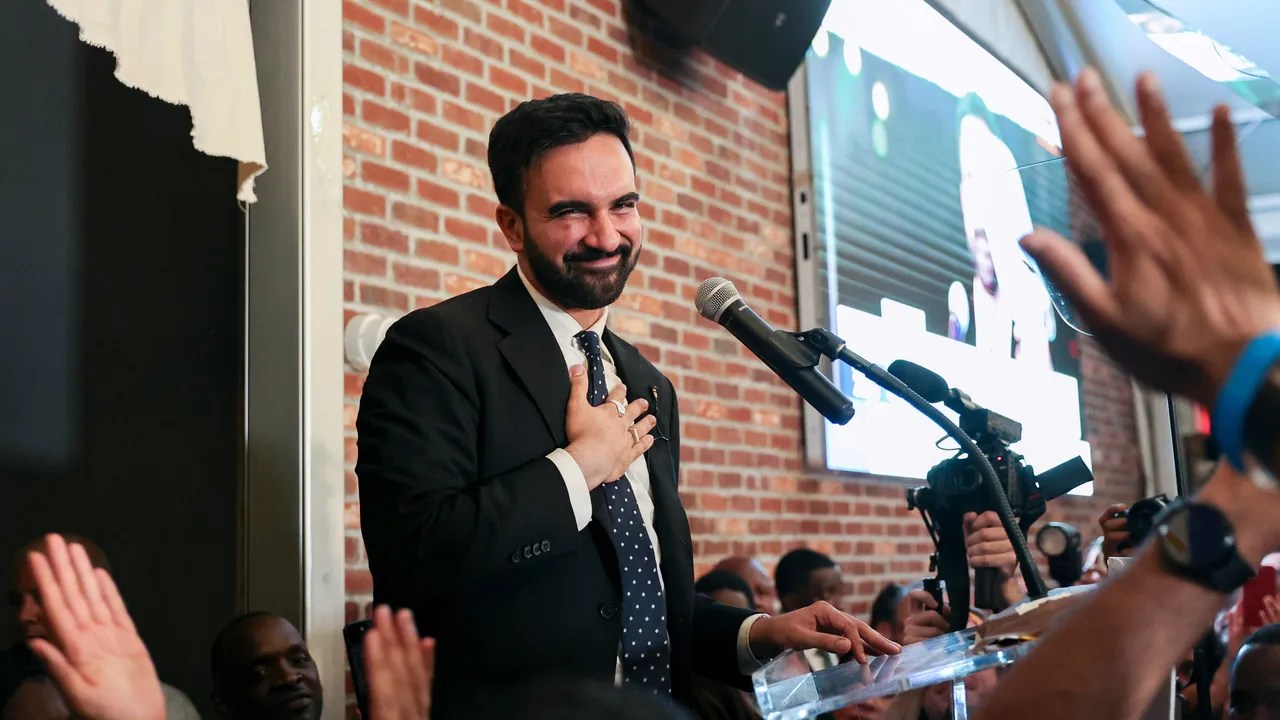
At a time when New Yorkers were fed up with aging establishment Democrats—like current Mayor Eric Adams (65), who last year faced federal charges for bribery and illegal campaign finance, or the disgraced former New York Gov. Andrew Cuomo (67)—a 33-year-old DSA “card-carrying” New York State Assemblymember, Zohran Mamdani, emerged from relative obscurity to take the city by storm and ultimately win the Democratic primary election this June.
Zohran’s youthful and energetic campaign created a grassroots volunteer base 30,000 strong–now 60,000–and exemplified a highly effective social media outreach strategy. The man-on-the-street short-form videos from outside MSG, for example, garnered hundreds of thousands of likes on TikTok. It was clear that Zohran and his staff were not just trying to attract young people on TikTok; they were themselves young people on TikTok. The hope of a grassroots, youth-centric movement on the Left began to emerge.
Unfortunately for leftists, the prevailing multi-class populist movement in American politics is MAGA. Trump handily won the 2024 presidential election by making enormous gains among groups once central to the Democrats’ base–working-class racial minorities and young people. With Republicans making tremendous gains among key demographics, it seemed like a counter movement on the Left was completely out of reach. Zohran Mamdani’s primary victory, however, offers hope of regaining key Democratic voters lost in 2024.
Ambivalently, while Mamdani ran a populist campaign, he himself is a member of the vilified privileged class that comprises the current Democratic leadership, raising questions as to whether candidates from elite backgrounds can authentically represent popular interests.
Raised in Morningside Heights from age 7 by Columbia University professor Mahmood Mamdani and filmmaker Mira Nair, Zohran attended private school in the Upper West Side and graduated from one of the city’s most distinguished high schools, Bronx High School of Science. He went on to the elite liberal arts college Bowdoin College, never needing to work a menial job or support himself financially before beginning a career in politics.
A major key to Trump’s success has been his anti-elite rhetoric (despite being a billionaire himself) aimed at Mamdani’s liberal urban elite milieu. Yet somehow, Mamdani won hundreds of thousands of working-class votes, including former Trump supporters.
He did so by distinguishing himself from establishment Democrats’ empty rhetoric and conveying clear and concise material objectives that directly benefit working people, like freezing the rent on rent-stabilized apartments, making buses free, no-cost childcare, and building city-owned grocery stores with guaranteed low prices. Policy over posturing is the Mamdani campaign’s strategy to earn the trust of working voters.
The New York Times’ final election map paints a clear picture of Zohran’s multi-class appeal. Unsurprisingly, “bourgeois” strongholds like the West Village, Williamsburg, and Greenpoint voted in droves for Mamdani. But Zohran also won big in neighborhoods made up of native New Yorkers and immigrants, like Jamaica Hills, Sunnyside, and Sunset Park. He even made tremendous gains in working-class neighborhoods like Brighton Beach and Bensonhurst that shifted towards Trump in 2024.
Many are still skeptical of Mamdani’s popular appeal, like author and cultural commentator, Rob Henderson, famous for popularizing the concept of luxury beliefs: “Opinions that confer status on the upper class at little to no cost for them, while inflicting serious cost on the lower classes.” The most famous example being “Defund the Police” (easy to say if you live in Greenwich, CT, or another community where street crime is virtually non-existent). Henderson believes Mamdani to be the “poster child for luxury beliefs” and that his policies aimed at raising the working class will ultimately harm them at no cost to himself and those of his ilk.
While Henderson correctly points out the imbalanced socioeconomic divide between New York’s largely black and brown working class and college-educated do-good liberals, asserting that what’s good for one class is bad for the other implies that class politics is always a zero-sum game.
While there’s an obvious social divide, the current state of the economy has accelerated proletarianization—the process by which sections of the middle class become absorbed into the working class. The American information class—whose power and status are derived from their control over information and knowledge (from specialized university training), rather than from owning traditional means of production—is currently afflicted with downward mobility, especially among young people.
College graduates who entered school expecting a stable middle-class income upon graduation find themselves underemployed and without traditional employer-sponsored benefits in an ever-increasing freelance or gig economy. A recent survey by Indeed found that 51% of Gen Z college graduates consider their college degrees a waste of money due to costs, student loan debt, and lack of viable opportunities post-graduation. When wages don’t keep up with productivity and the cost of living continues to skyrocket, especially in a city like New York, middle-class comforts are eviscerated.
The silver lining when everyone is struggling is that people across identity groups form shared economic goals and build a broader democratic coalition. The New Deal, for instance, was born out of the catastrophe of the Great Depression, and spawned an era of socially democratic economic policies that resulted in an unprecedented time of prosperity for lower- and middle-class Americans. While these gains were unevenly distributed towards white men, the post-war era was defined and made successful by the inclusion and ascendence of non-whites, women, and immigrants in the workforce.
Similarly, today, popular economic policies—like the ones put forth by the Mamdami campaign— lift all ships. Whether it’s a struggling single mother in the Bronx working two jobs to support her children or a 20-something media professional transplant struggling to make their student loan payments, Zohran’s rent freeze policy benefits a broad range of New Yorkers.
While the campaign highlighted economic issues, it can’t be said in good faith that Mamdani compromised his leftist social values to pander to a more conservative voter base. He publicly displayed support for marginalized groups like immigrants and LGBTQ+ — positions that are highly divisive to many voters.
However, unlike what has become the traditional Democratic all-or-nothing rationale on social positions and shaming those with alternative positions (those from conservative working-class backgrounds), Mamdani took a more nuanced approach. In an interview with Stephen Colbert on The Late Show, Mamdani quoted former New York City Mayor Ed Koch, “If you agree with me on nine out of 12 issues, vote for me. 12 out of 12? See a psychiatrist.”
Mamdani acknowledges that unanimous agreement is nearly impossible, but that doesn’t mean you can’t still win elections. We don’t have to be best friends with our fellow party members, but we must be aligned on the most important issues to make real progress. Social values will always be up for debate, but the most important job of the democratically elected representative is to implement policies that elevate material conditions for their constituents.
Look for moral guidance from friends, family, philosophers, or religious leaders. Not politicians.
It hasn’t always been smooth sailing for Mamdani since the shocking primary victory. He’s been the subject of frequent and heavy criticism in the media. Even powerful members of his own party have refused to support him.
Israel’s war in Gaza has been the media’s preeminent issue in their coverage of Mamdani, a longtime supporter of Palestinian rights and critic of the Israeli government. The campaign’s biggest scandal thus far came from Mamdani’s use of the phrase: “Globalise the Intifada” — a slogan that comes from the Palestinian liberation movement to depict their struggle against Israeli rule. The Arabic word intifada means “to throw off something that oppresses.” Zionist groups describe the phrase as a call to violence against Jewish people. Mamdani, however, insists he did not use the phrase to encourage any kind of violence and has since said he will discourage its use going forward.
Throughout the race, Mamdani has been asked a series of ‘gotcha’ questions posed by his opponents and agenda-promoting journalists, like whether or not he will visit Israel. He plainly responded that he “need not travel to Israel to stand up for Jewish New Yorkers.” But for Mamdani’s opponents, fighting antisemitism and supporting Jewish New Yorkers isn’t enough–one must completely and uncritically support the Israeli state and its military’s occupation of Gaza.
Cuomo has made it his mission to prey on the fears of Jewish New Yorkers by painting Mamadani as a hateful radical, calling anti-Zionism (which he equates with antisemitism) “the most important issue” of the campaign. But why are Mamdani’s opponents so hyper-focused on a conflict in the Middle East that the mayor of New York has no power to affect whatsoever? It is an attempt to distract and deflect from what’s really at stake in this election if Mamdani wins—a major blow to establishment politics and the ruling class.
Mayor Adams shook up the race on Sept. 28 by announcing the end of his campaign, directly benefiting former Governor Cuomo, who stands to gain most of the votes Adams would have received. Even still, Mamdani maintains a significant lead, but current polling has yet to reflect the full impact of Adams’s exit.
Cuomo’s backers are reinvigorated now that there is one less candidate to compete with. “Now he has a chance,” said 83-year-old media mogul Barry Diller, who has already donated $250,000 to Cuomo’s campaign and pledged an additional contribution. Fellow billionaire and Cuomo-backer, Bill Ackman, chimed in on social media, thanking Adams for stepping aside and imploring Republican candidate Curtis Silwa to do the same. And of course, our billionaire Commander in Chief offered his two cents in light of the Adams news, posting on Truth Social, “Remember, [Mamdani] needs the money from me, as President, in order to fulfill all of his fake communist promises. He won’t be getting any of it, so what’s the point of voting for him?”
Clearly, the ruling class one-percenters are running scared at the nearly realized possibility of a Mamdani mayorship. The key to overcoming their attempts to sabotage his campaign through misleading rhetoric, attack ads, and quid pro quo deals to sweeten the race in their favor is for Zohran’s supporters to keep unity based on shared economic interests alive in the spirit of the famous political slogan, “We are the 99%.”
The “Mamdani Effect” is already making waves across the nation, inspiring progressive young candidates to carve out their place in the Democratic establishment. We’re seeing its effects already on the opposite end of the country, where a Mamdani-inspired leftist push is underway in Portland, OR’s city council. Who knows how far this movement could spread if Zohran Mamdani is elected Mayor of the largest city in the most powerful nation in the world?
The prospect of a more equitable, socially democratic New York City is real. And if the Knicks win a championship under his administration, Zohran deserves a ring.


Leave a Reply