
(Photo Credit: Nicholas Occhiuto via X)
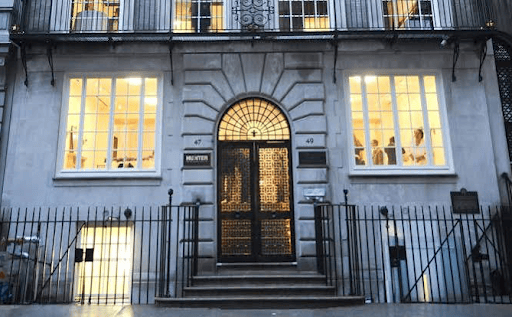
In a brightly lit conference room inside Franklin and Eleanor Roosevelt’s old house, Hunter Sociology Assistant Professor Nicholas Occhiuto presented his research to students and faculty on Sept. 17 from his forthcoming book, “Lobbying and the Making of American Oligarchy.” The event, titled “From Bureaucrats to Billionaires: Race, Lobbying, and the Making of American Oligarchy,” is part of Roosevelt House’s Discussions in Public Policy (DIPP) series.
Joseph Lowndes, director of the Public Policy Program, calls it “A terrific and rare opportunity to see what faculty research looks like” and a way for students to “Ask questions and think about how they might pursue research in the future.”
Occhiuto’s talk tackled how Americans are governed: more than 70% believe corporations and the wealthy have too much sway over politics, according to Pew Research. His research explains this by tracing how congressional employees, or staffers, particularly of color, cycle through Capitol Hill and into the lobbying firms that represent those same corporate interests.
The Revolving Door
Occhiuto says the oligarchy that seemingly appears in the government actually begins behind the scenes at Capitol Hill, in the workplaces of Congressional staffers. According to him, more than 60% of lobbyists previously worked as congressional staffers or members of Congress, where they amass the social connections and expertise needed to work for the interests of corporations and billionaires.

He tracks the career path of ‘revolvers’: congressional staffers, often young people who started as Capitol Hill interns, who move through government jobs and eventually into lobbying firms representing corporations. By interviewing roughly 200 former congressional staffers, he found that race heavily shapes the revolving door.
One of the former staffers Occhiuto interviewed was Nia, a Black staffer who survived the January 6th insurrection at Capitol Hill. To maintain anonymity, former staffers referenced in his book and presentation went by their first names. Nia was abandoned by her boss after escorting him to an undisclosed location. Nia and her colleague, a Black man, were left to find safety on their own. Nia told Occhiuto that she “Had never been so close to so many guns before,” and described feeling separate from her body on the traumatic walk back.
Nia’s terrifying experience, Occhiuto said, reflected broader patterns he encountered in interviews with Black former congressional staffers, including experiences of being underpaid, passed over for promotion and isolated in the workplace.
Occhiuto argued that these experiences have consequences beyond individuals’ careers and mental health. He pointed to data showing that senior staff are white in 82% of congressional offices and said Black staffers leave Capitol Hill after an average of four years.
He connected that turnover to Congress’s ability to do its work, arguing that staffers’ departure also means the loss of specific expertise and relationships with constituents. In his presentation, Occhiuto argued that the high level of turnover leaves many positions unfilled; he notes that a D.C. office may have only seven to nine staffers responsible for handling the legislative workload of more than a thousand bills each year.
“We are hemorrhaging people of color from the most important legislative body in the United States,” Occhiuto said, and therefore losing their “Embodied lived experiences that are not being factored into the legislative process.” He argued that when lobbying firms recruit staffers who have spent years building connections on Capitol Hill, the early departure of Black staffers can also shape who enters the lobbying industry and whose experiences are represented within it.
The racism found on Capitol Hill that Occhiuto refers to starts with something as ordinary as the universities that Congresspeople choose to look to for internships.
“Has anybody here had somebody come and table here [Hunter] about congressional internships?,” he said.
The entire room shook their heads. By recruiting almost exclusively from Ivy-plus schools, where Black and Latino students are already underrepresented, Capitol Hill builds an elite pipeline that filters out the students most likely to diversify it.
During the Q&A, students asked Occhiuto about the experiences of other minority groups on Capitol Hill and the motivations of revolving-door lobbyists. The Envoy asked what Occhiuto would tell students who want to get involved in politics but feel discouraged by the current climate.
“We need as many young people to be engaged as can possibly be engaged,” Occhiuto said.
He also said there are opportunities to make a difference at every level of civic engagement, and getting involved with politics through social media, such as the DSA’s page, is a great place to begin. For students interested in interning in Washington, D.C., but unsure if their work will make a difference, Occhiuto says not to discount the experience. “We need as much representation, lived experiences, and expertise across all avenues of politics,” Occhiuto said.
Despite the exhausting experiences of the non-white revolvers, Occhiuto contrasts it with what one former staffer who wished to remain anonymous told him: “Not even to the last day was I not in awe of the work I was doing.” While Capitol Hill is a place of incredible wealth and inequality, Occhiuto says that it remains “The source of American power,” and he adds that it needs “People who are willing to take on that fight with the full knowledge that it will not be easy.”
Occhiuto isn’t just studying this pipeline: as political manager for Darializa Avila Chevalier, the Democratic nominee for New York’s 13th Congressional District, he’s one of the only white staffers on a campaign run largely by people of color.
“Some of those people are going to Capitol Hill,” Avila Chevalier said.
The next event at the Roosevelt House is Students Defend Democracy! on Sept. 28. It features two workshops, titled “CUNY Gets Out the Vote” and “Defending Against Attacks on Voting,” and an evening program called “Race, The Ballot, and the Fight for Democracy,” which will discuss the roots of election fraud discourse. Lowndes calls it a “Day of democracy,” and all students are welcome to attend.


Leave a Reply