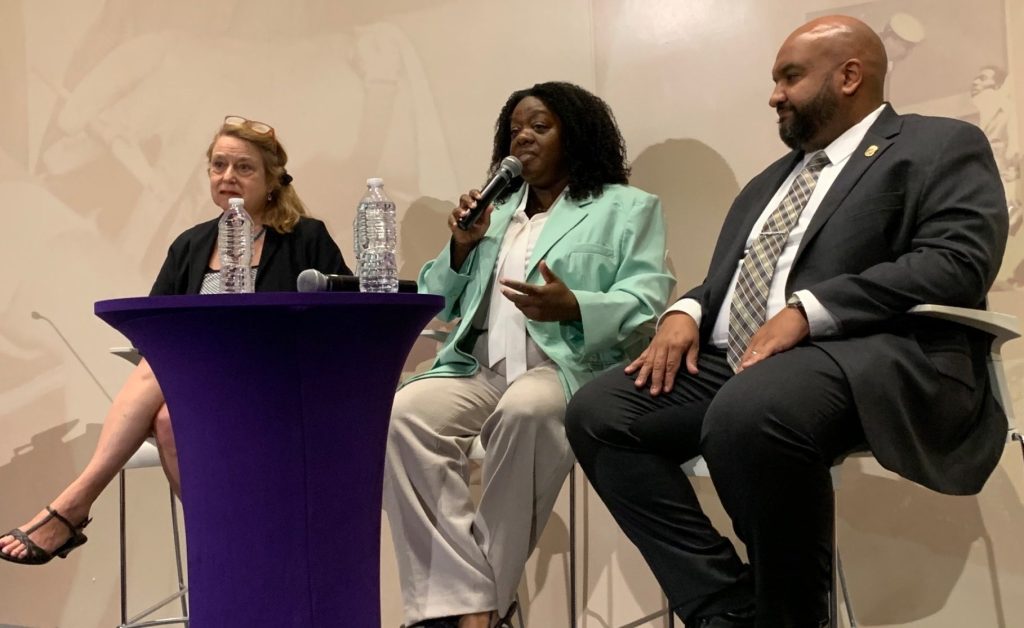
Moderator Laura Wolf Powers, panelist Sideya Sherman and panelist Ahmed Tigani on 9/14/2026 (Photo credit: Sauda Afrose)
Two Hunter alumni heading Mayor Mamdani’s effort to combat housing insecurity spoke to students and faculty at the Roosevelt House on Sept. 14th.
The discussion with Department of Buildings (DOB) Commissioner Ahmed Tigani (‘2013) and Director of the Department of City Planning (DCP) & Chair of the City Planning Commission Sideya Sherman (‘2003), was moderated by Hunter College Urban Policy and Planning Professor Laura Wolf-Powers.
Mayor Mamdani ran his successful campaign on tackling the housing crisis in New York, a city where nearly a third of residents spend half their income on rent.
According to their own estimates, the city would need 290,000 homes right now and 700,000 over the next decade to house everybody in need. One of the Mayor’s housing plans, called Block By Block, is set to build 200,000 and restore 200,000 units over the next decade.
“A big piece of this is the process itself costs money,” said DOB Commissioner Tigani. “For DOB, I’m thinking about that construction period and our process coming in faster so that the costs go lower.”
Another limitation to speed is the dual-mandate of safety. “DOB is just trying to make sure the paperwork is in place, and that the boiler is not going to explode, and the building is not gonna collapse on anyone,” he said.
According to the March 2026 report released by the NYC Department of Investigation (DOI), 165,000 families are on the New York City Housing Authority (NYCHA) waitlist as of March 2026 and more than 6,000 units remain vacant for sometimes up to a year.
“It almost feels like every minute that ticks by there’s like a family that has to wait somewhere else,” Tigani said.
Tigani said DOB is looking into faster alternatives, like many other city agencies, they are often constrained by different laws, implementation requirements, costs, and questions about where the money will be coming from. Mamdani established the SPEED Task Force in January to examine “every step of the housing approval and development process and identifying how we
can move faster, smarter and more effectively”; also expediting environmental reviews for affordable housing.
“It is absolutely crucial that New Yorkers have affordable, safe places to live,” Sherman said.
The NYC True Cost of Living Measure report shows that 62% of New York City residents, almost 5.04 million people, do not have the resources to cover the true cost of living in the city and there is a $39,603 average annual gap between available resources and costs.
Sherman also discussed some ways DCP has incorporated public feedback into their policies including survey tools and an online medium called Voice to Vision where constituents can provide both structured and unstructured feedback to the agency about various neighborhood plans. DCP also hosts “walkshops” or walking workshops where staff are trekking through neighborhoods with planners, urban designers, elected officials to take note of places of opportunity and priority.
“The way that I approach this work is certainly not top-down, it’s not necessarily bottom-up either, it’s really the government and the community meeting in the middle,” Sherman said.
What about the students?
“Student housing has a history of not being designed with students in mind,” said Marisol Chinn Ardon, a student at Hunter College. “Housing should be built better and student housing needs to be more affordable.”
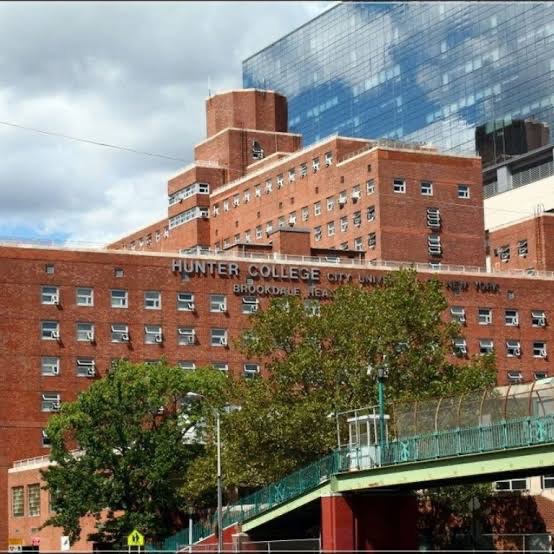
Hunter College has a population of over 22,000 students, however, only a slim number of that pool are able to access student housing. The college dorm applications are also competitive and housing isn’t always guaranteed as the institution only offers about 260 beds. Dorm space has been especially tight after the closure of the Brookdale dorms in 2024, which were the biggest dorms under the college, offering beds to about 600 to 700 students. Hunter has obtained 648 new beds to replace those lost at Brookdale, and redevelopment is currently underway.
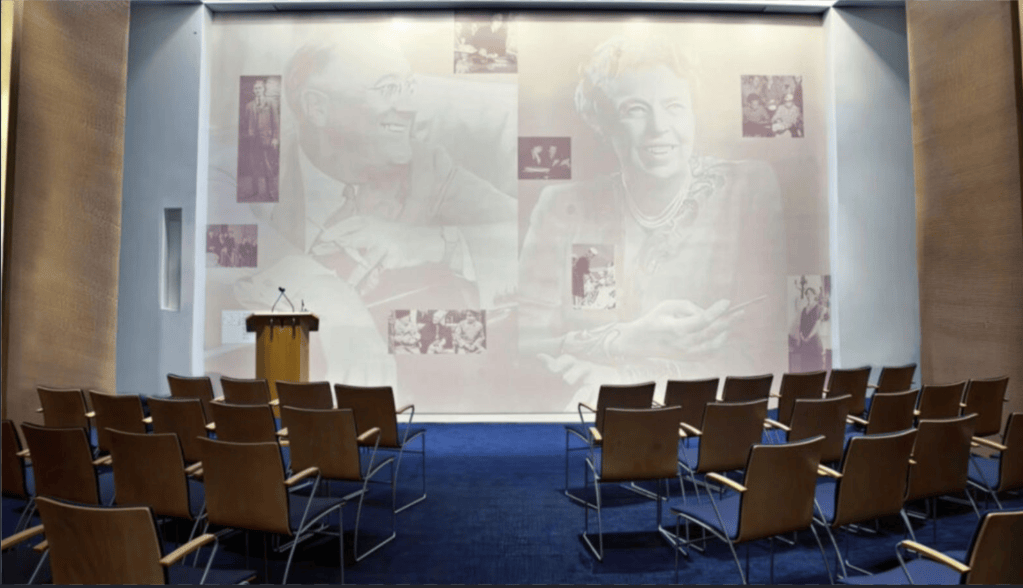
Roosevelt House Auditorium (Photo credit: Hunter College)
The college’s Provost Manoj Pardasani says he does hear concerns often about housing in the NYC community, particularly about affordable student housing. He says that since the closure of the Brookdale dorms, Hunter College President Nancy Cantor has ensured that dorm rooms are available at two separate locations and that funds are subsidized. The current open dorms under Hunter are located at Lexington Avenue 51st Street and 79th Street in the Upper East Side.
“These are issues we’re trying to address by raising private funds, getting more donors and funders, you know,” he said.
He also said that if a problem arises then democracy is important and students should voice the issues to the Hunter Undergraduate and Graduate Student Government.
“People need to advocate. There’s always power in numbers,” Pardasani said. “Those elected representatives of student government have a direct line to the president, to me and to other leaders in the college.”
The panel, “Civic Participation in the Mamdani Era” is part of a larger series called “Promoting Civil Discourse & Intellectual Dialogue” made by President Nancy Cantor in 2024. In a letter addressed to the Hunter College community, she says that the series intends to foster communication across divides and host moderated discussions where the community can explore global problems and safely express personal sentiments.
“We want to emphasize the power of communication and dialogue,” Pardasani said regarding the series.
Students, faculty, and members from outside of the community can all attend these events and also recommend speakers or issues to discuss. Some upcoming events include a special screening of the film “Emergent City” made by Hunter College Film and Media Chair Kelly Anderson and Jay Arthur Sterrenberg and another screening of “Sex Work: It’s Just a Job” which highlights the plight of sex workers in the New York City community.


Leave a Reply