
In the early morning hours of February 26th, five federal agents entered an off-campus Columbia University-owned residential building and arrested Elmina “Ellie” Aghayeva, a student from Azerbaijan. Aghayeva, a social media influencer, alerted her 114,000 Instagram followers by posting a photo from the back of a vehicle. The caption read: “Dhs illegally arrested me. Please help.”
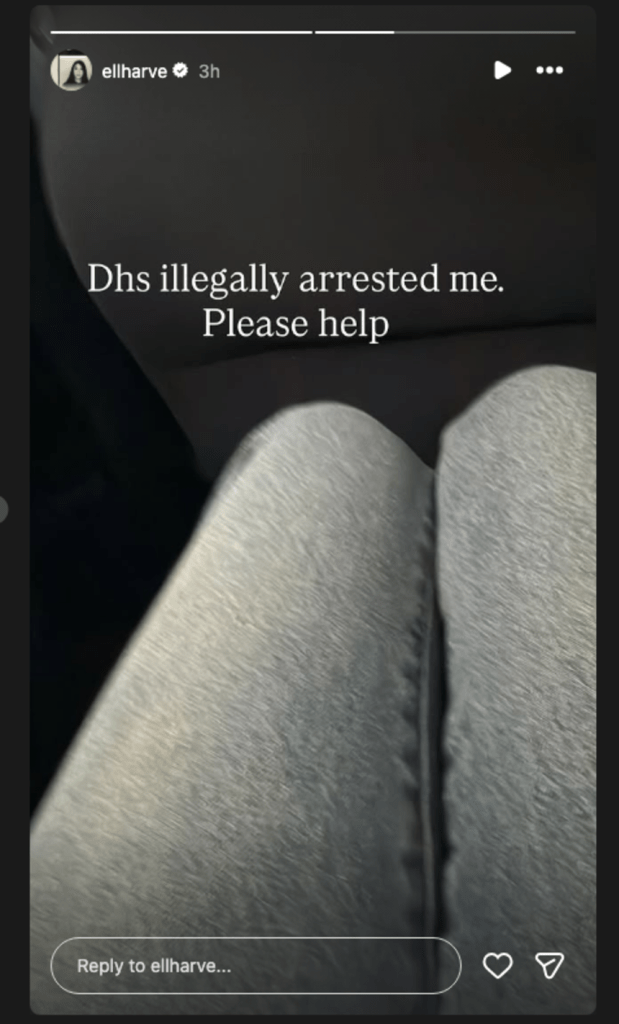
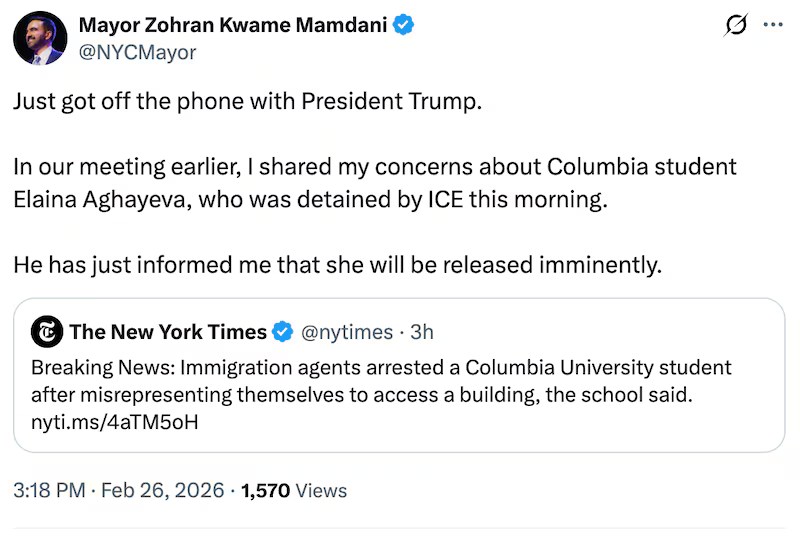
Aghayeva was taken to an ICE facility in Lower Manhattan and detained for several hours. She was ultimately released later that day after Mayor Mamdani beseeched President Trump to release the 29-year-old Columbia Senior. News of the arrest made national headlines and sparked social media discourse about the legality of the arrest and the agents’ tactics.
Following the events, Columbia’s Acting President Claire Shipman released a statement detailing how DHS agents obtained entry onto private university property. She explained that the agents were let into the building and later into Aghayeva’s apartment after misrepresenting themselves as local police searching for a missing child. When their true intentions became clear, Columbia Public Safety arrived on the scene and asked the agents for a warrant, which they did not produce. Following university protocol, the Public Safety officer asked for time to call his supervisor, but the agents dismissed the request and left with Aghayeva before a call could be made.
Shipman condemned the incident as a “breach of protocol,” but it was unclear what protocol she was referring to. Notably, Shipman did not describe any actions taken by the federal agents as illegal, creating uncertainty as to whether or not immigration officers are permitted to make arrests on university property without a warrant.
Since Donald Trump retook office in January 2025, there have been multiple high-profile cases involving arrests and attempted deportation of New York City college students. Just like the incident involving Ellie Aghayeva, fellow Columbia students Mahmoud Khalil and Yunseo Chung were also subject to searches of their university housing by federal immigration officials. Unlike the Aghayeva case, however, the agents who arrested Khalil and Chung obtained warrants signed by a judge.
Like all law enforcement agencies, ICE cannot search private property, including university housing, without a judicial warrant per the 4th Amendment:
“The right of the people to be secure in their persons, houses, papers, and effects, against unreasonable searches and seizures, shall not be violated, and no Warrants shall issue, but upon probable cause, supported by Oath or affirmation, and particularly describing the place to be searched, and the persons or things to be seized.”
Cristina Rodriguez, a professor at Yale Law School, highlights that the Constitution uses the term “people” or “person” rather than “citizen.” The 4th Amendment protects everyone on U.S. soil, documented or undocumented. However, our legal system also allows law enforcement officers to deceive “the people” into waiving their constitutional rights.
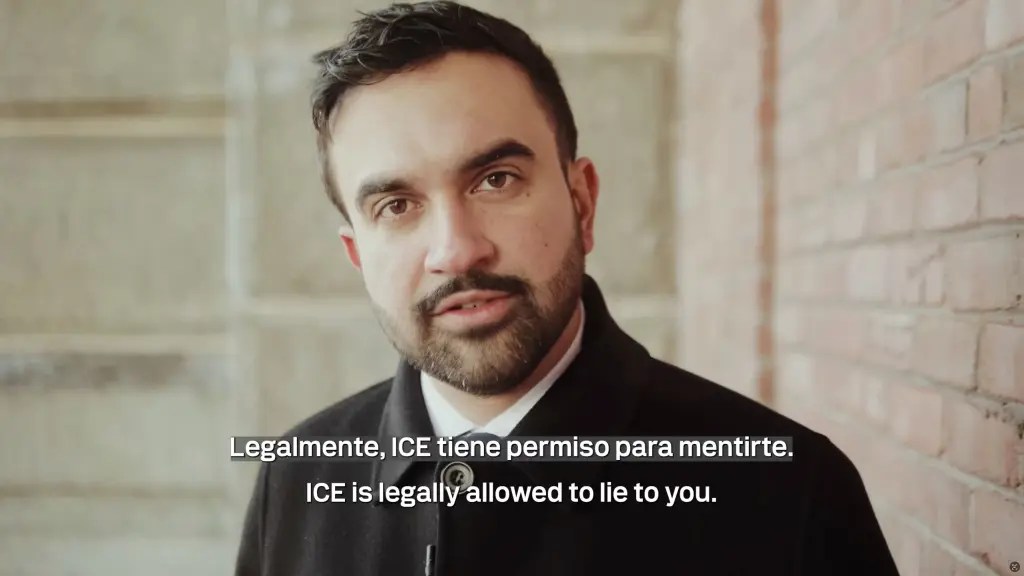
As in the case of Ellie Aghayeva, ICE agents routinely use deceptive tactics to gain entry into private spaces when they do not have a warrant. In a social media video, Mayor Mamdani warned New Yorkers that “ICE is legally allowed to lie to you.”
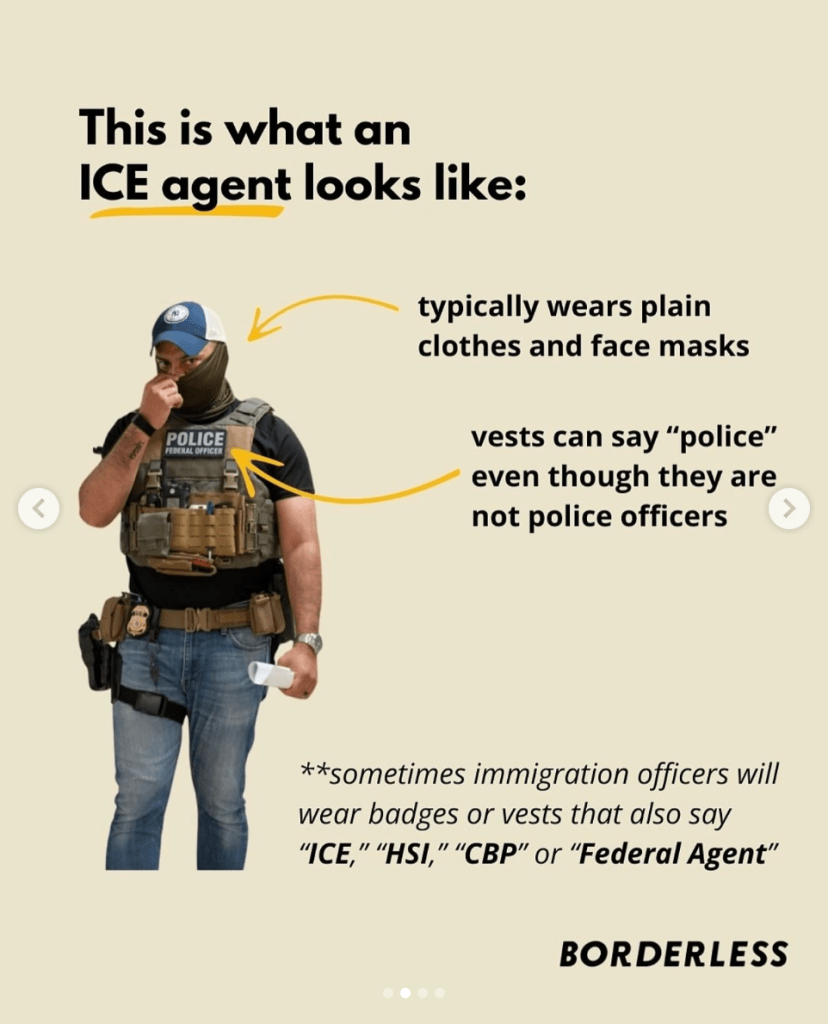
The preferred term in law enforcement is “ruse”. Ruses are officially sanctioned and taught to new agents at the ICE Training Academy. Past ICE ruse operations have ranged from posing as door-to-door religious missionaries to soliciting construction services for a fake business. The most common practice is for federal agents to misrepresent themselves as local law enforcement and invent a non-immigration reason for their inquiry. Official ICE training manuals instruct agents to obscure their agency affiliation and to instead refer to themselves generally as ‘Police’ or ‘Federal Officers.’
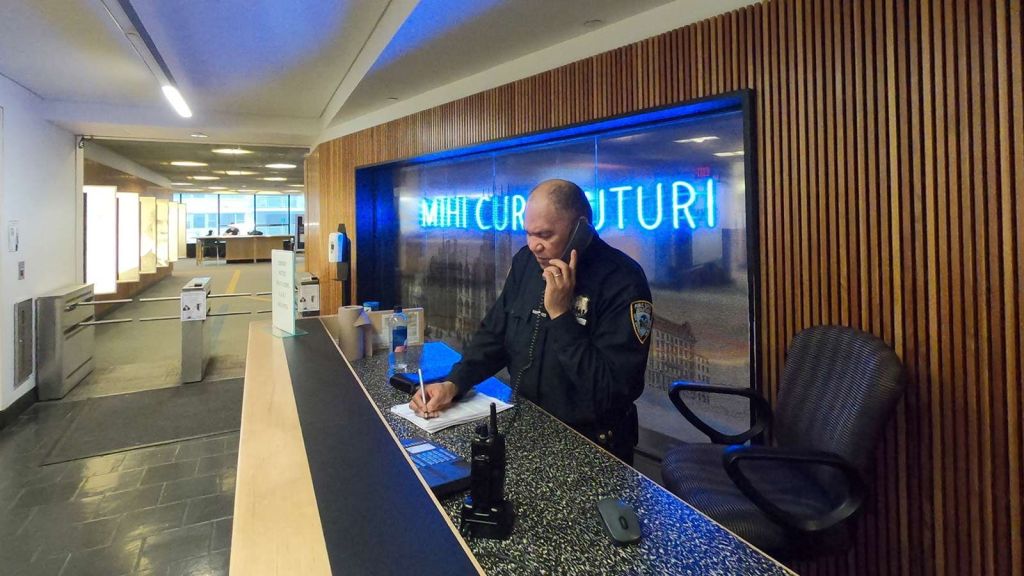
Hunter College Public Safety’s Access to Campus by Law Enforcement policy does not permit law enforcement agents on school property, except when compelled by law (judicial warrants, court orders, subpoenas, etc.). Yet, for most people, including Public Safety staff, it can be difficult to assess the legitimacy of such documents.
The Immigrant Defense Project—a New York City-based immigrant advocacy group—explains how ICE tries to take advantage of the average citizen’s limited knowledge of legal documents: “Even though ICE agents may say they have a ‘warrant,’ they are often referring to administrative warrants. The administrative warrants they have are not the same thing as a judicial warrant. The administrative warrant that ICE agents carry is an ICE form, is not signed by a judge, and does not require the same legal standard to obtain as a judicial warrant does.”
Only the Hunter College Office of Legal Affairs can grant access to law enforcement. The official policy states: “Because it is difficult for an untrained person to determine the validity of such documents, it is vitally important any warrant, court order, or subpoena presented by law enforcement seeking access to Hunter College/HCCS facilities or records be reviewed by the Hunter College Office of Legal Affairs.” If law enforcement requests access, Public Safety staff are required to ask the officers to wait while they alert the Director of Public Safety, who will alert the Office of Legal Affairs.
However, ICE has consistently disregarded laws and policies they disagree with. Columbia Public Safety followed a very similar protocol to Hunter College’s, but federal agents did not comply with requests for a warrant or time to alert supervisors when arresting Ellie Aghayeva. Additionally, a federal judge in Minnesota estimated that ICE had violated nearly 100 court orders during Operation Metro Surge.
(Photo Credit: Hunter College)
Whether Hunter College’s policy works in practice remains unknown. The Hunter College Office of Communications confirmed “Hunter College Public Safety has documented zero instances of immigration officers appearing on campus since January 2025,” and added that “Leadership at Public Safety does not recall any [encounters before January 2025] involving immigration officers on or around campus.”
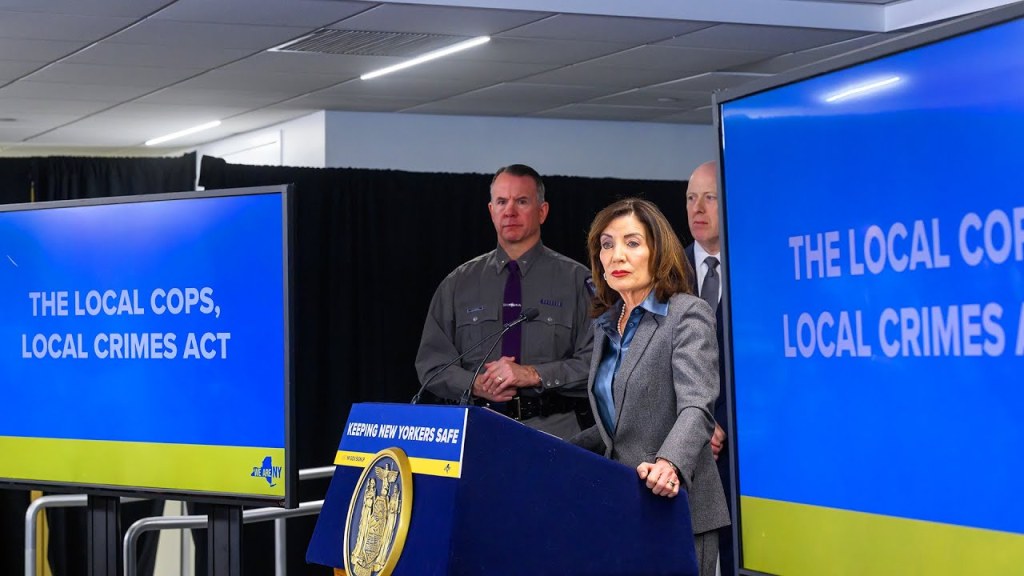
New policies have been proposed at both the state and federal levels in response to ICE’s actions on college campuses. Governor Hochul’s Local Cops, Local Crimes Act aims to reenact protections for “sensitive locations” (schools, houses of worship, and private homes) that Trump repealed on his first day back in office. ICE could still access these locations with a judicial warrant, but the proposal makes it much more difficult to do so. It reestablished sensitive locations as legally prohibitive zones and grants New Yorkers the right to sue federal officers for state-level constitutional violations.
Governor.NY.GOV)
U.S. Representative Adriano Espaillat (NY-13) has proposed similar legislation in Congress. Espaillat’s Protecting Sensitive Locations Act additionally expands the scope of sensitive locations to include “federal and local courthouses; DMVs and social security offices; polling places; labor union halls; and several other locations which provide essential or emergency services to immigrant communities, such as rape crisis centers and homeless shelters.”
Whether either bill will be passed into law is uncertain at this time. While legal protections and DHS accountability remain limited, CUNY and Hunter College offer resources for students, faculty, and staff impacted by immigration policy. The CUNY Immigration Assistance Project (CIAP) offers free attorney consultations on a variety of immigration matters. CUNY Citizenship Now! assists all New Yorkers (CUNY-affiliated or not) to apply for U.S. Citizenship and legal benefits programs. The Immigrant Student Success Center at Hunter College (Room 305 –
Thomas Hunter Hall) provides resources to all undocumented and immigrant students to navigate financial aid and support. Additionally, the Hunter College Committee to Defend Immigrants (HCCDI) published an Immigrant Rights Defense Packet which provides a comprehensive overview of what to do if encountered by immigration officers.


 The Envoy
Leave a Reply