By: Ana Agudelo, and Victory Ogunnaya
Gen Z is no stranger to social media. Apps such as Instagram, Snapchat and TikTok are part of the cultural zeitgeist. In college, platforms like Yik Yak have become known as spaces where students can share memes, report campus activity and interact casually.
Now, Fizz: Campus Communities is positioning itself as the next trending app, marketing itself as an “authentic community” to college campuses nationwide.
According to its website, Fizz is “a discussion and news feed for your community, whether thats for your school or city.”
Two students, Teddy Solomon and Ashton Cofer, at Stanford created Fizz in 2020 during the pandemic and launched it at Stanford in December 2021. The company says it has expanded to 700 schools in five years. Fizz plans to launch at Hunter College after expanding to New York City campuses such as Pace University, Fordham University, and the Fashion Institute of Technology. Access to college communities on the app requires proof of enrollment (campus-specific emails), keeping posts limited to verified students.
It is also easy to request the app at a new campus: users can submit a form expressing interest.
Community-building spaces matter, especially at commuter schools and during a period when young people report increasing social isolation. Although Fizz aims to create communities, the app may not solve those feelings of isolation and lack of community.
Critics on social media have accused the app of violating student privacy and functioning more as a gossip forum than a community platform. Unlike other social media apps, Fizz relies on moderators selected from within each campus community rather than third-party oversight. It also uses a voting system, meaning a single moderator cannot remove posts independently.
That structure may appear fair on the surface, but critics have argued otherwise.
At Pace University, one student, Sophia Meza, said the Fizz app has become more visible on campus since its launch. Meza said it is mostly used to share opinions, ask questions and post about campus life, with content ranging from “funny or relatable” to occasionally “negative or even uncomfortable.”
The anonymity is what stands out the most,” Meza said. “It makes people feel more open to speak honestly, but it can also lead to people saying things they wouldn’t normally say in person.”
Meza added that in order for the app to remain safe and positive, the app needs to hold users accountable and verify information.
Many users have also said it has enabled bullying and harrassment. TikTok users have reported waking up to find themselves the subject of viral posts on Fizz. Reports of these incidents have surfaced at predominantly white institutions and historically Black colleges and universities across the nation, causing a lot of controversy.
Ricardo Miranda, head of the emerging media concentration at Hunter College, said apps like Fizz follow a familiar pattern in the evolution of social media.
“The first thing that came to mind is a second coming of Facebook,” Miranda said, referencing the platform’s early days as a college-only network at Harvard University.
Miranda compared Fizz to early online bulletin board systems, where users operated anonymously. While those spaces allowed people to connect over shared interests, anonymity often encouraged “abusive behavior, bullying, sexism, racism, and hatred,” he said.
He also pointed to earlier online communities, including women-focused networks such as ECHO BBS, as examples of how platform design has shaped who participates and how safely they engage.
“These patterns of bad behavior persist across anonymous online platforms,” Miranda said.
Miranda offers an insight into the concerns that have arisen regarding the issues with anonymous platforms.
Gabriela Peña, a student at Hunter College, said the Fizz app is generally seen as part of normal campus life, though not without limits.
Peña said if it does launch, she hopes most content is light-hearted and conversational, and added that if “it becomes offensive, that’s not okay.”
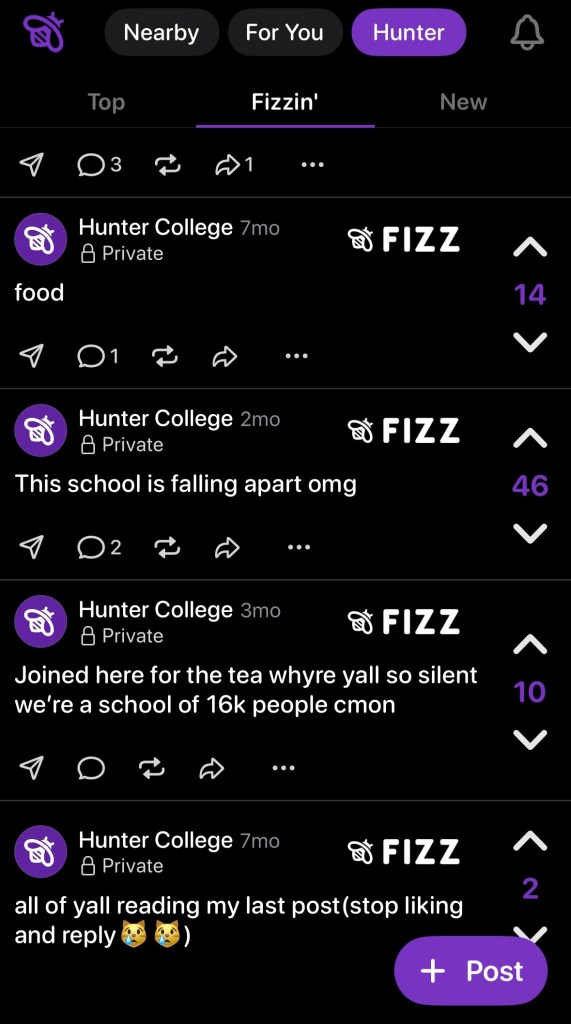
A review of the Fizz platform showed posts appearing under the Hunter College community, including questions about party life, campus infrastructure, and personal issues. However, the account associated with the app’s Hunter College launch on Instagram has not been updated to confirm whether the rollout has officially occurred.
Its bio still states, “ONLY launching at Hunter if this account gets 2,700 followers by Sunday.”
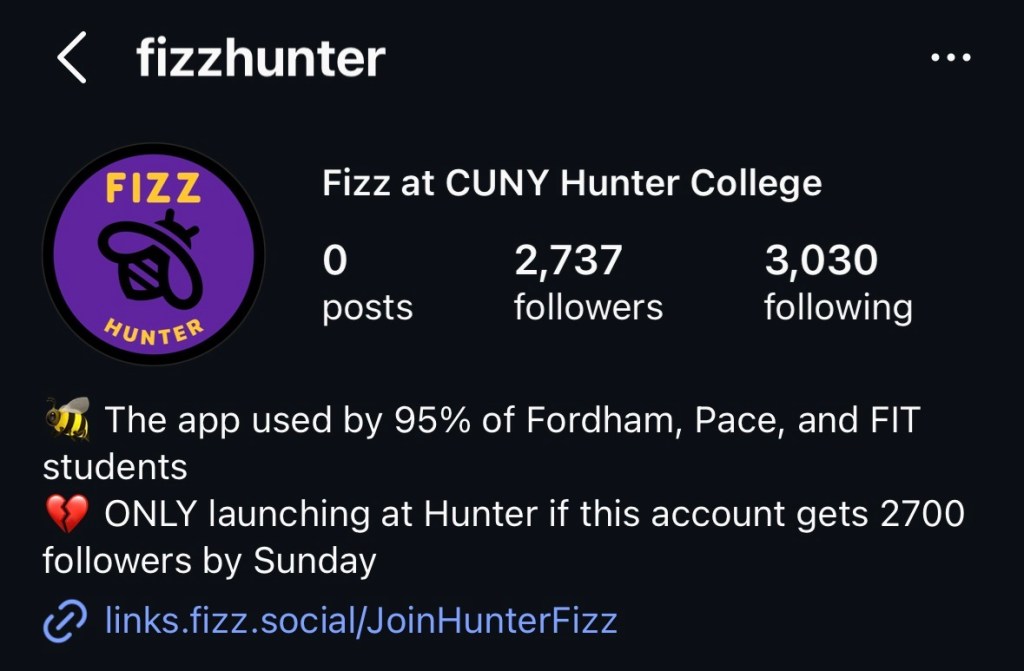
Attempts to reach the user behind the Hunter College Fizz Instagram page @fizzhunter for a quote were unsuccessful.
The status of the app’s official launch at Hunter College remains unclear.


 The Envoy
Leave a Reply