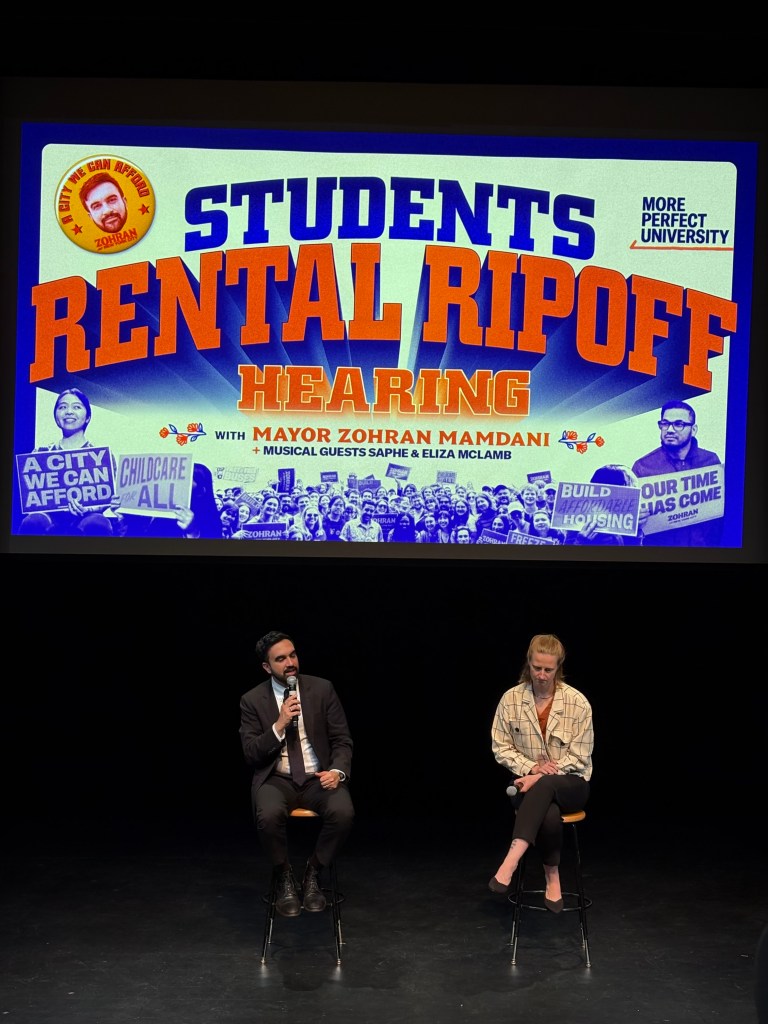
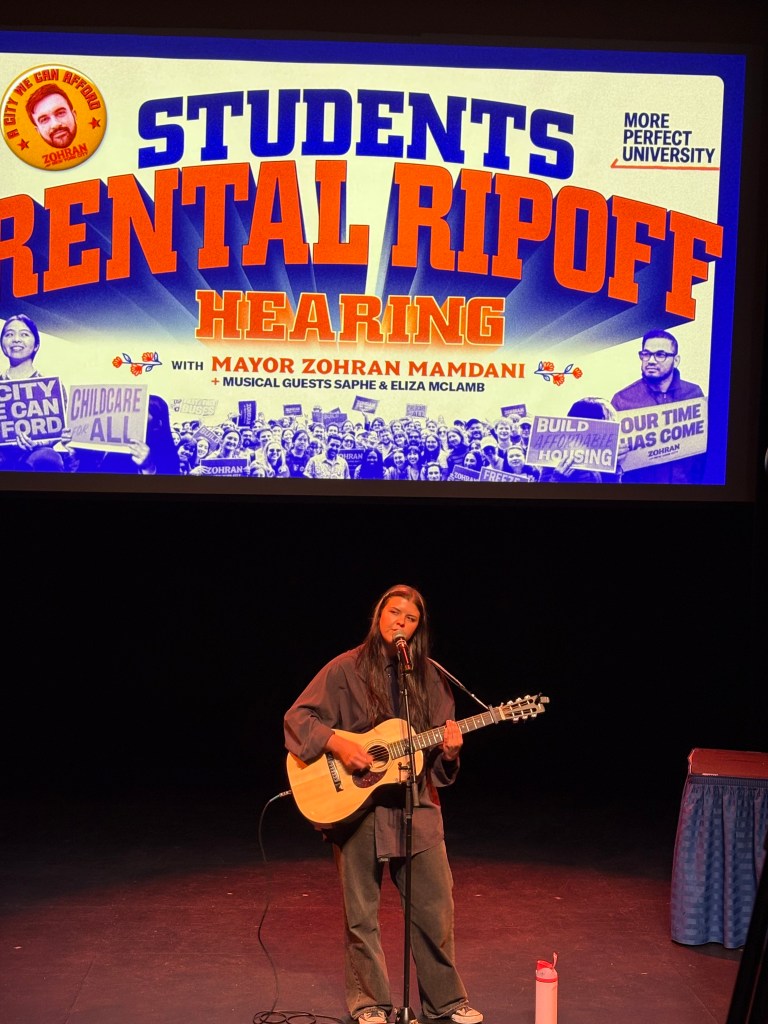
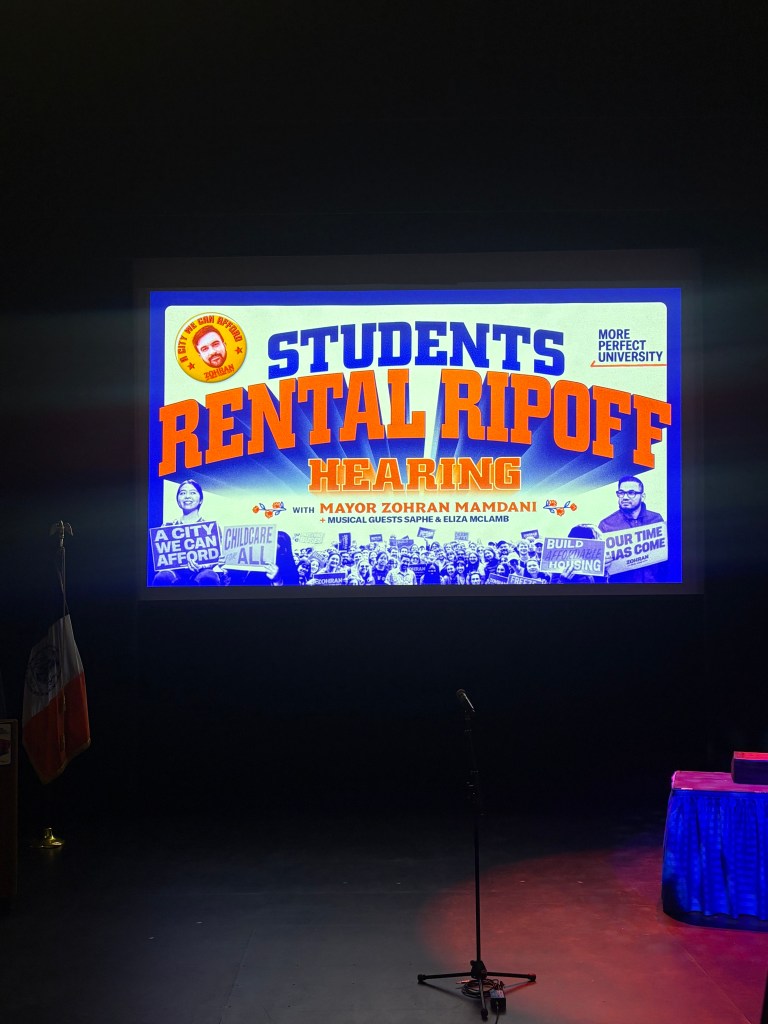
The oppressive, early-summer heat of late May hung heavy inside the Hostos Community College auditorium in the South Bronx. Throughout the hall, attendees desperately fanned themselves with political pamphlets, attempting to catch a draft of cool air. Yet, despite the overbearing heat, there was a lingering anticipation in the air. As the crowd scrambled to claim any remaining seats, organizers tapped at microphones, running final sound checks to clear the stage for the night’s opening acts: DJ Saphe and indie rock musician Eliza McLamb.
Throughout the room, City University of New York students and New Yorkers alike all shared one common goal: to ask Mayor Zohran Mamdani questions about the housing crisis in New York City. Many had documents open on their electronics, scrolling furiously through notes, speeches, and stories they wanted to share. Others quietly recorded the performances, swaying their heads and bodies to the rhythms of the music. Young CUNY students, Bronx natives and New Yorkers from across all five boroughs filled these rows, each eager and filled with hope.
Unlike many other rental rip-off hearings across New York City, this student rental rip-off hearing was organized by More Perfect University, a newly launched student organizing project by the nonprofit news organization More Perfect Union. At this hearing, students and New Yorkers had the opportunity to engage in a Q&A with Mayor Zohran Mamdani and Cea Weaver, the Director of the New York City Mayor’s Office to Protect Tenants. The event allowed for students and individuals affected by the affordability crisis to openly discuss these issues and hear from politicians about how they plan to address them.
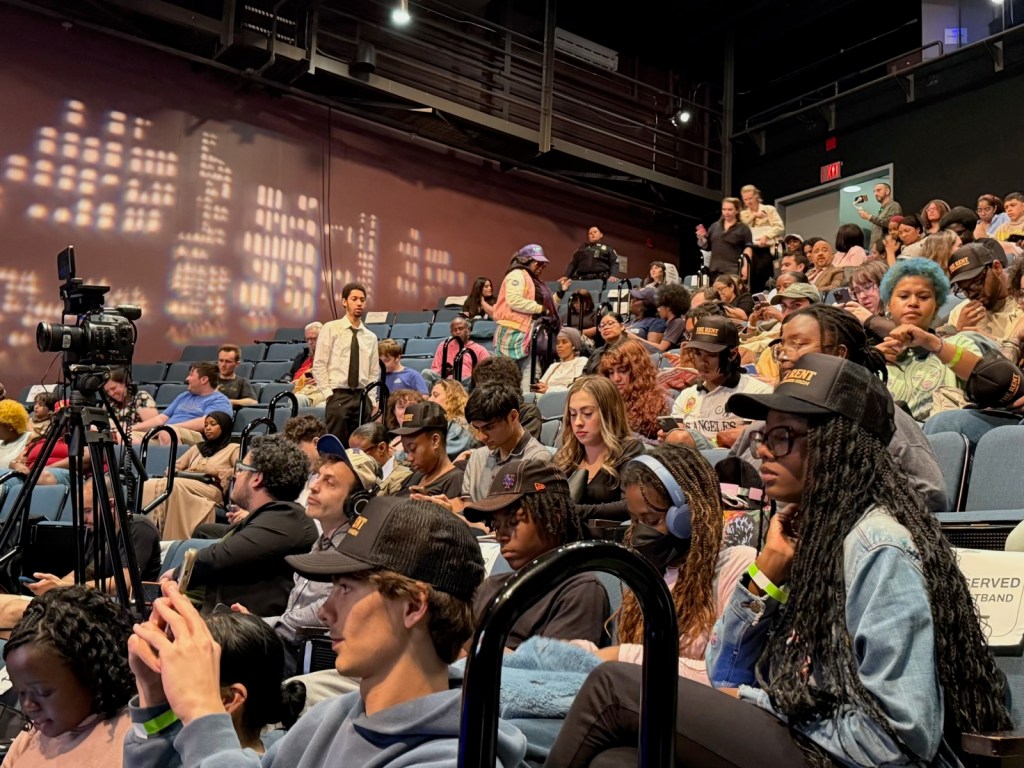
New York City is currently experiencing its most severe housing affordability crisis in years; for many New Yorkers, more than 50% of their monthly income goes toward paying their rent. Not only are they experiencing severe rent increases, but also unsafe living conditions and a lack of accountability from their landlords.
At the event, Mamdani framed the crisis not as an unavoidable actuality but rather as a political failure.
“This crisis did not arrive by accident – it has been decades in the making,” Mamdani said. “It has been a direct result of decisions that government has made.
For Mamdani, these decisions that empowered landlords were one of the main things he wanted to tackle.
“Decisions that gave landlords the incentives to spike rents and push New Yorkers out of their apartments,” Mamdani said. “Our government will no longer treat 70% of New Yorkers that do not own their own homes as afterthoughts.”
Mamdani shared with the audience his plan to tackle housing inequality through his initiative, “Block by Block: The Housing Plan for a New Era,” which he had released two days before the event. The initiative is meant to ensure that New York City meets the urgency of the housing affordability crisis through a $22 billion capital investment over the next five years. During that time, the program aims to construct 200,000 new affordable, rent-stabilized homes and preserve at least 200,000 more, offering a multi-step plan that ensures New Yorkers feel optimistic and secure when looking for a home. This program essentially offers New Yorkers a new sense of hope that they’ve long dreamt of – an affordable New York City.
“We never want you to come to the conclusion that you must leave the city in order to live your life. Mamdani said, “We want you to stay in this city so that you can build your life.
For many students and community members sitting in that Hostos auditorium, the program’s long-term vision was far more intimate.
At CUNY, roughly half of undergraduate students come from families that earn less than $30,000 a year, and about half of those work while attending school. Many students find themselves in positions where they struggle to attend classes and afford living in the city.
“Students know more than most how difficult it is to find housing you can afford in New York City,” Mamdani said. “Whether you move to be closer to campus or you’re living at home, you know what a 1.4% vacancy rate looks like.”
For many young people at the event, that five-year plan feels very out of reach. When the floor finally opened for discussion, many didn’t just ask for details of the plan; instead, they demanded to know how this program would protect them now, not just in the long run. Throughout the auditorium, young student activists were desperate for the city to execute their promises. That tension was captured by a student activist from East Harlem representing the Sunrise Movement – a group of young New Yorkers working to combat climate change who stood amongst them and asked about the participation of young activists with City Hall. For him, it was important to learn how young student activists like himself could engage with City Hall to ensure that Mamdani’s plan doesn’t remain only “words on a page.”
Other Bronx natives demanded accountability from the Mamdani administration by highlighting the institutional forces that are displacing communities in their neighborhoods. Some even shared their experiences living near Columbia University, where they have seen major universities operate as businesses rather than educational institutions, and demanded to know how the administration would regulate these universities and protect longtime tenants.
Mamdani and Weavers’ response pointed toward a strategy focused on community and activism. They both emphasized that grassroots organizing is the best tool possible against powerful institutions like private universities. In his plan, Mamdani is determined to give tenants the legal tools necessary to build organizations and unions to fight back against this crisis. Yet despite the administration’s aspirations of collective change through tenant power, many CUNY students are skeptical of the program’s promises.
For students like Samir Ghimire, a John Jay College student, these big promises have forced him to keep in mind the reality of the New York City housing market. While Ghimire noted that the plan “sounds great,” he emphasized the same skepticism many CUNY students feel when vital city plans are shared with the public.
“Hopefully he can back up what he says,” Ghimire said, “I don’t know if we have the infrastructure capacity in place for us to build affordable housing so quickly in such a quick period of time.”
New York City’s housing crisis has long been impacted by the New York City Housing Authority – a corporation intended to provide stable and affordable housing to New Yorkers. Throughout the night, attendees reflected that although NYCHA offers affordable homes, many are left living in unstable living conditions, from broken elevators to broken heating systems to undrinkable water.
Representatives such as Syrah Scott of the National Clean Water Collective Youth Council work with students across New York City on a project called the “Poison Imprisoned Pipeline.” Their main goal is to raise awareness about lead exposure and advocate for water testing and water filtration solutions to help protect New Yorkers. For Scott, one of her main concerns was that many tenants are paying premium rates for housing yet lack safe drinkable water.
Scott asked, “What steps would you take to ensure that renters are not paying increasingly high housing costs while still facing potential lead exposure in the water coming into their homes?”
Part of the organization’s goal is not to hold every landlord accountable, but rather to ensure they don’t have to. The plan is to hire enforcement agents across their agencies that will inspect buildings and apartments for lead in New York City.
“My dream is that every landlord is responsive to their tenants, and that every landlord is following housing code,” Mamdani said. “That is how we are looking at this because, frankly, this is the law. And for too long housing code has been treated like a suggestion.”
Not only did organization representatives highlight the structural issues they’ve witnessed, but real estate advisors who have seen the displacement of hundreds of New Yorkers also spoke on issues they’ve seen firsthand. Alon Solé, owner of his real estate brand, the New York Bricks, attended the event in hopes of raising awareness on the Fordham Landing Project, a major housing development in University Heights, The Bronx. The project, which would create 5000 affordable housing units, has filed for bankruptcy under the primary developer, Dynamic Star LLC.
For Solé, his goal was to discuss the project and ensure it moves away from City Hall and actually creates affordable homes for New Yorkers.
“I would like to see somebody step in from government and fund the project,” Solé said.
Solé believed this event served as a great platform to raise awareness on the housing affordability crisis specifically in the Bronx.
“I think there should be better screening in the future on who gets to take these affordable housing projects in the Bronx,” Solé said.
As the campus-organizing wing of More Perfect Union, More Perfect University designed this event specifically as a “student rental rip-off,” creating a space for individuals who are too often left out of these political conversations, like representatives, students, and real estate agents.
For Elise Joshi, the head of More Perfect University, the focus on Mamdani’s platform and campaign reflects a generational alliance in priorities.
“Housing is such a critical issue for young people,” Joshi said. “First-time tenants are the most vulnerable as they enter the housing market unknowingly of how greedy landlords can be.”
Joshi is working alongside students to provide them with immediate tools to fight back.
“We are doing a ‘Rate Your Landlord’ national campaign alongside University of Pittsburgh students who are building a website that helps students hold their landlords accountable,” Joshi said.
It is evident that youth response is becoming highly organized and essential, and this event was a testimony to that. For many working-class students across the CUNY system, the truth of Mamdani’s “Block by Block” plan will be measured in the actual cranes and diggers used to create the new homes in the city that never sleeps. For Joshi, the growing student activist housing movement is concrete proof that youth organizers are no longer suppressed.
“This was made possible because of tenants, particularly young tenants like you,” Joshi said. “Young people, we are passed off as naive, but we know that narrative is intentionally crafted by bought-out politicians to maintain a system that doesn’t work for working people.”



Leave a Reply