(Photo Credit: Alex Augenbraun)
Amid rising fears over AI safety and an absence of federal oversight, New York is setting bold new regulations meant to curb students’ unfettered use of technology.
Following a plea for the federal government to regulate the rapidly developing technology by Anthropic CEO Dario Amodei, President Trump made it clear he is not interested, posting on Truth Social:
“The only control or “guardrail” that AI needs is a STRONG AND SMART (High IQ!) President”
New York officials disagree.
“The president has said we don’t have a problem as long as we have a president with a high IQ,” NYC Public Advocate Jumaane Williams said last Tuesday. “That means we have a very big problem.”
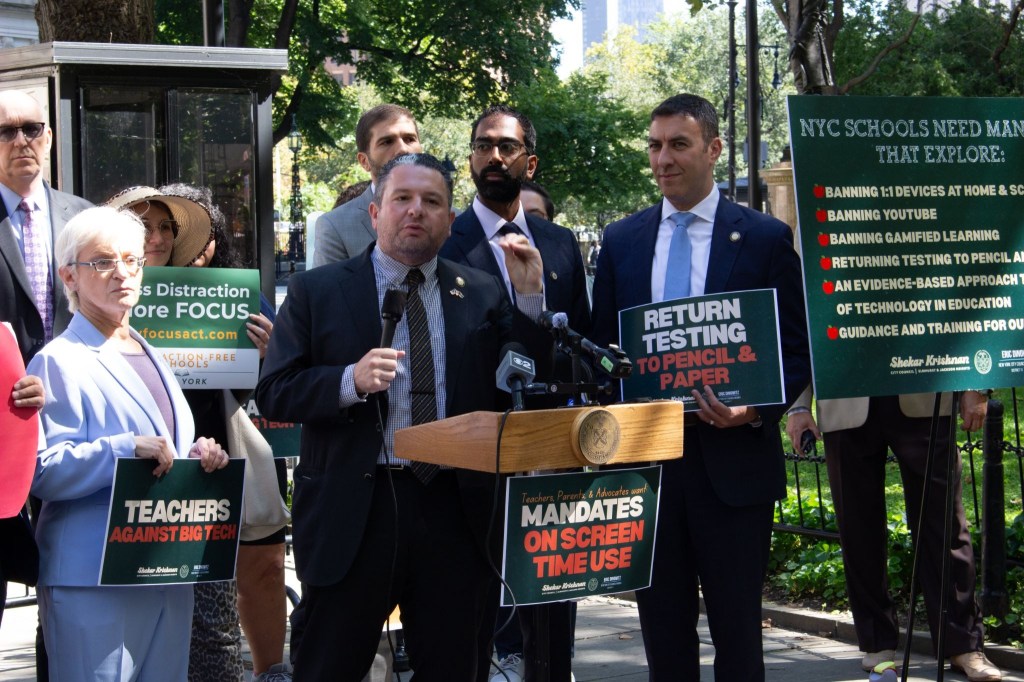
“This is a bipartisan issue,” said Republican Councilmember Frank Morano.
A week before students returned to school, Mayor Zohran Mamdani announced a 1-year moratorium on AI, banning its use in pre-K – 8th grade and significantly limiting high school students’ and teachers’ use of it.
Councilmembers lauded the effort, but said the policy must go further.
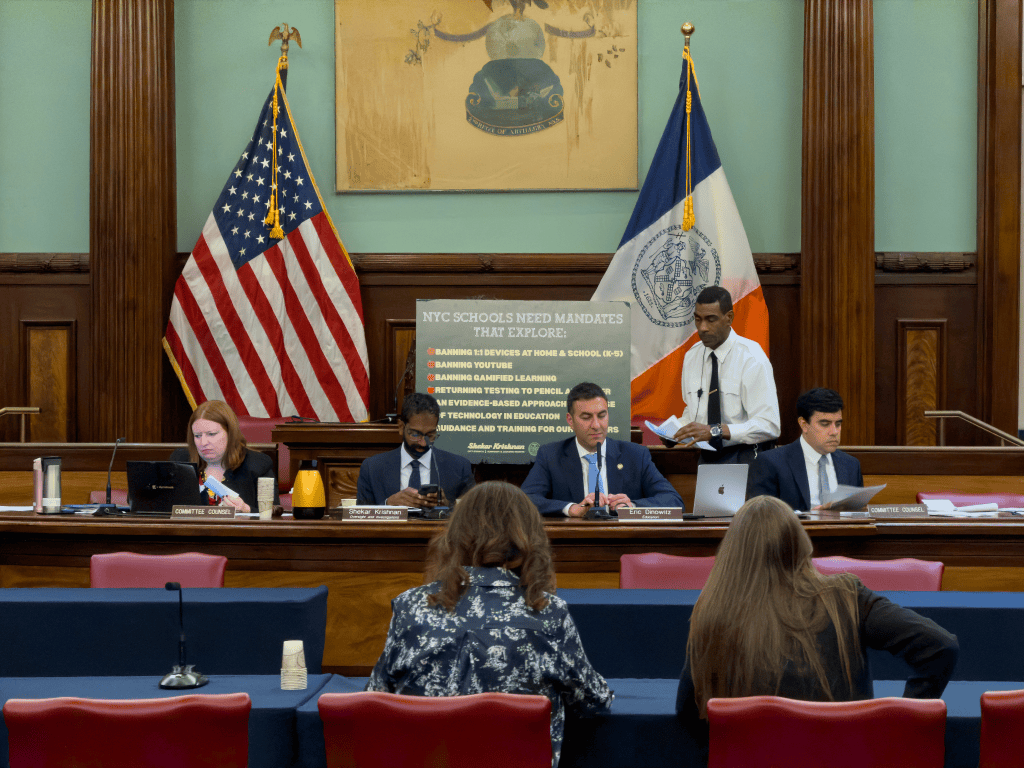
The Education and Oversight committees held a joint hearing at City Hall on Tuesday, Sept. 15, titled: “Examining Screen Time and the Use of Digital Devices in New York City Public Schools.”
Councilmember Eric Dinowitz, chair of the Committee on Education, began the hearing by discussing his time working as a teacher during the Covid-19 pandemic. “Like every other teacher in our system, I had to teach through a screen overnight. No preparation, no warning, no choice. Today we have a choice,” Dinowitz said.
“Undergirding the guidance from the DOE lies an assumption that the DOE has yet to defend with robust evidence: that screens are good and necessary,” Dinowitz said. “I disagree.”
Council members cited studies, including Brookings research referenced by the DOE, that have linked increased screen time to lower test scores. “This year, overall reading scores for students between third and eighth grade dropped six percentage points compared to last year,” said Speaker Julie Menin, “and third-grade proficiency alone sank by nearly 14%.”
Aracelis Lucero, executive director of the nonprofit Masa, which helps immigrant and marginalized communities, testified that her son was reading above grade level in kindergarten. “I have seen how, over the years, my son has started to struggle in literacy,” she said.
“He’s now reading at grade level but has fallen behind in writing. I’m sorry, this is upsetting to me.”
The Details:
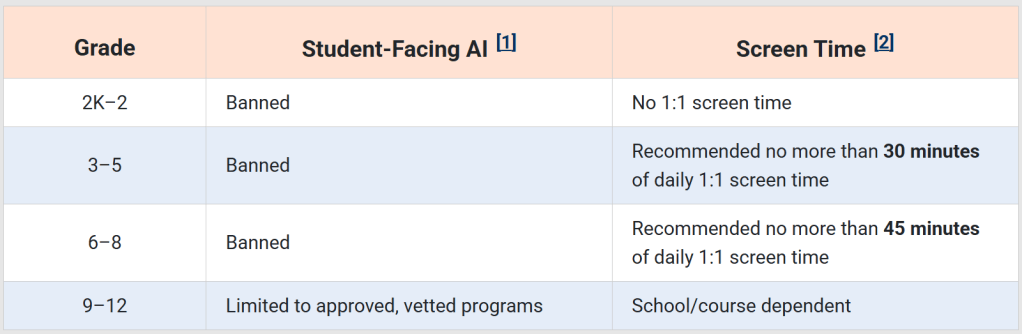
Under the guidance, students in pre-K through second grade get no individual devices. Third through fifth graders are recommended 30 minutes a day, and sixth through eighth graders 45. High schoolers have no cap; their device use depends on the course. Digital assessments, assistive technology for students with disabilities and multilingual learners, remote days and programs like coding and robotics are exempt.
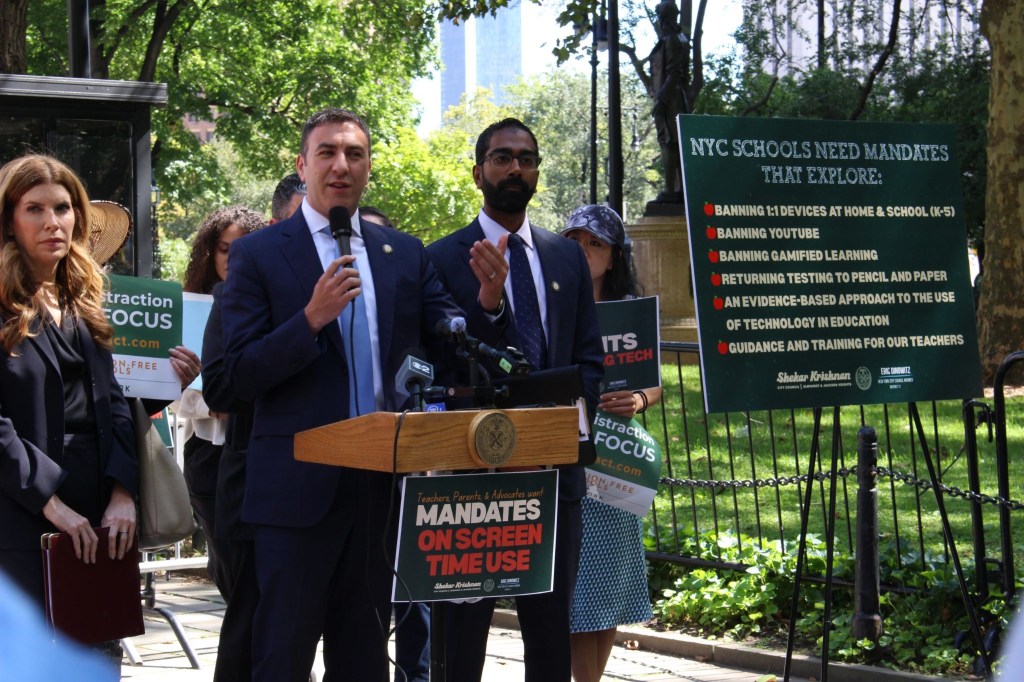
Councilmember Shekar Krishnan, chair of the Oversight Committee, questioned why many of these new policies are “recommendations” as opposed to “mandates.” “This moment requires more than recommendations,” he said.
DOE First Deputy Chancellor Danielle Giunta said that while they don’t want the policy to be punitive, these recommendations are non-negotiable.
Time spent taking assessments will not count to the daily limit, but teachers are asked to adjust other classes’ screen use on days with big tests. DOE officials said there is no opt-out for core curriculum.
Then there is YouTube. Scott Strickland, the DOE’s Deputy Chief Information Officer, told the council that as of 5 p.m. last Wednesday the department had filtered YouTube off all student devices. Later in the hearing, Kate Mulvaney, a parent of a second grader, told the committees: “I literally accessed YouTube on my son’s school-issued device this afternoon, and anyone who’s interested can take a look. I have it right here.”
Data and Consent:
Dennis Doyle, the DOE’s chief privacy officer, said the department does not collect parental consent before sharing student data with vendors. It relies on a federal FERPA exception for school contractors. “I don’t think we should be relying on the exception,” Krishnan said, urging affirmative consent. Asked how many data privacy audits the DOE had conducted last school year, officials did not have a number.
Hunter College High School senior Alma Adi, testifying for the NYCLU’s Teen Activist Project, raised the same concern about the high school AI pilots. “We, as students, need more transparency about how our data would be used,” she said.
What’s Next:
After roughly four and a half hours, DOE officials said they would follow up with their research citations, a list of 38 previously allowed programs with AI features, and the audit numbers. State Sen. Andrew Gounardes urged the council to write the screen time limits into local law so they outlast this administration.
“The house is already on fire,” Public Advocate Williams said. “It’s about how long we’re going to allow it to burn.”


 The Envoy
Leave a Reply