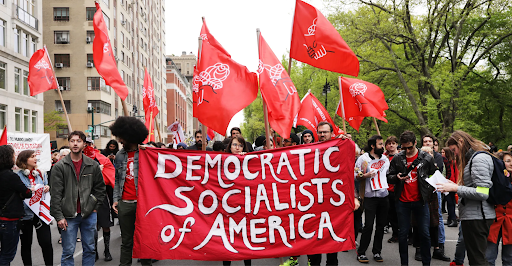
When you walk into a coffee shop near Hunter College, you can get shocked by the price of a latte. If you work, that one cup can eat up around half of what you make in an hour at your probably minimum-wage job. As students, we may feel powerless against rising prices. So we pay, we feel guilty, and we tip anyway, even though the Chief Executive Officer should have been paying livable wages in the first place.
Most of Hunter College’s population lives in New York City, where many of us experience the high cost of living. I live in a one-bedroom apartment, a reality shared by many Hunter students I’ve spoken with. Even students who live in more spacious places often trade proximity for privacy and endure long commutes from the city’s outer edges. Meanwhile, students at more prestigious institutions may come from generational wealth, while billionaires buy more properties and the lower classes continue to struggle financially. Despite these disparities, both groups from vastly different economic backgrounds are expected to eventually support themselves financially. These contrasts stay well hidden from the news, because the media outlets the general public turns on every evening are funded by the bourgeoisie who benefit most from class struggle.
So why do we accept it?
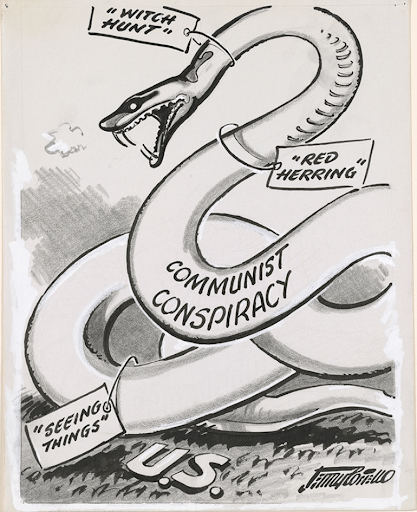
As students, we are taught to stay quiet and listen to those in positions of power. The media reinforces that lesson by pushing the idea that a capitalist regime creates a true democracy. The Red Scare (an era of immense propaganda shoved into civilians’ faces to convince people that capitalism was the best economic system) may be decades behind us, but its effects are still evident today. Not through posters of beasts, but through sly reminders telling the common person, or, more simply put, us, to keep our heads down and not ask who benefits.
To find out whether anyone on campus is pushing back, I interviewed a faculty member who regularly discusses these ideas in his classes: Professor Vescovi, who teaches Sociology 101 and Sociology 22400 at Hunter College.
Will our generation actually take down capitalism?
Vescovi didn’t sugarcoat it. “I don’t realistically see this generation dismantling capitalism,” Vescovi said.
In his view, capitalism will keep its bare-bones structure for now, and that isn’t comforting, because those bare bones could mean nothing but a market economy and authoritarianism. But he still has hope.
With Mayor Zohran Mamdani and Democratic socialists winning across the country, Vescovi described real excitement and urged students to take these ideas seriously. He hopes students push for policies that benefit the public and allow public ownership in the industry again. He was careful to add that it’s a risky path, since many political movements don’t last.
He said the biggest obstacle is education, and this is where the Red Scare comes back in. As he taught in Sociology 101, anti-communism has become close to a national religion in the United States, making it hard to reach people with ideas that could actually benefit them but terrify them in various ways.
Q: Who owns what, and why?
I also asked what pushed Vescovi away from capitalism. He said we live it in a nuanced, powerful way, and he started with his own childhood: hearing parents argue about bills and what would be taken away if something went unpaid.
Pressure is capitalism, landing on individuals and families alike.
Still, studying Karl Marx, the renowned German philosopher and political economist, gave him real passion. Looking at the system, he realized that it’s deeply unfair, and that the real question is who owns what, why they own it, and why it isn’t collectively owned.
From there, his advice to Hunter students centered on class consciousness, something he says working-class and middle-class Americans lack. In a Marxist model, those two groups are the same class with the same interests. Middle-class families have more resources, but they’re one job loss away from the working class, and he said the middle class needs to come down off its high horse and see that its values align with working people’s.
His prescription had three parts: get educated, organize, and get involved in politics.
Capitalism reaches each of us individually, through what we consume and the dreams we’re told to chase: money, wealth, success. There’s nothing wrong with wanting those things, Vescovi explained. The challenge is to stop and ask whether we really want it or whether we could all have a stake. It doesn’t necessarily mean everyone’s living an austere life with one pair of pants and one pair of shoes. We already live in a highly industrialized world that can produce plenty, so there’s no reason that abundance can’t be spread across the many instead of pooled among a few. The only other route, he added, is revolution,
“Which is a whole other story,” Vescovi said.
Organizing at Hunter
Hunter’s Democratic Socialist Club gave me a more student-centered response. Members told me about the City University of New York’s encampments at CCNY in response to the genocide in Palestine, which they believed achieved some feasible change by shifting public opinion on the genocide. They argued that CUNY hasn’t done enough to divest, and they cited a figure of 1.8 million dollars going toward weapons for Israel.
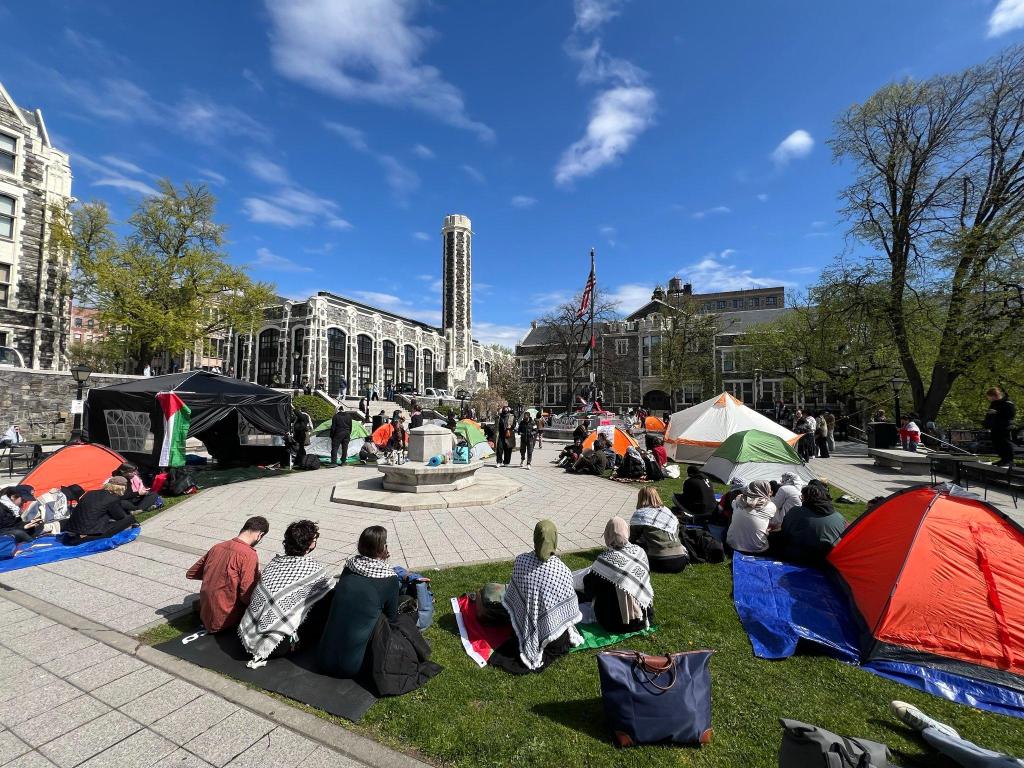
For them, the goal goes beyond Hunter College. They want to dismantle these systems across the entire city by training the next generation of organizers and giving them a space on campus. So far, that has meant know-your-rights training, including visits to small businesses to teaching owners about their rights.
If they had one message for Hunter students, they said that in order to create change, we have to get organized by joining local unions that fight against billionaires.
“We are all under a system that concentrates power and money in the hands of a few, and if we don’t fight for change, we’ll never get it,” one member said.
When radical isn’t even radical anymore:
Will our generation overtake an entire movement of capitalists funded by the top one percent, or, as Marx would call them, the bourgeoisie?
Probably not, at least not all at once. But I don’t think that’s the only way to measure it.
Marx’s idea of alienation is a good place to start. Students, especially, are alienated from one another, set up to compete for grades, internships, and spots. The “lock in” mindset can be really unhealthy, as if the real issues people face just to get anywhere economically aren’t consuming. We’re told to grind harder when the problem was never our effort.
That’s also why Mamdani’s label matters. Socialism has become more palatable, and democratic socialism is the version voters just elected, even though the majority of Republicans oppose it. A word the Red Scare taught generations to fear now wins elections in one of America’s largest cities.
History also shows how change doesn’t happen at once. Think of Che Guevara, the Argentine-born revolutionary who helped topple Cuba’s government and remake its economy with only a small band of soldiers. I’m not saying we all pick up arms, but the story proves that a few determined people can shift what’s possible.
For students, the tools look different: educate yourself, organize, join a union, show up, vote, and yes, rebel in whatever form that takes.


Leave a Reply